
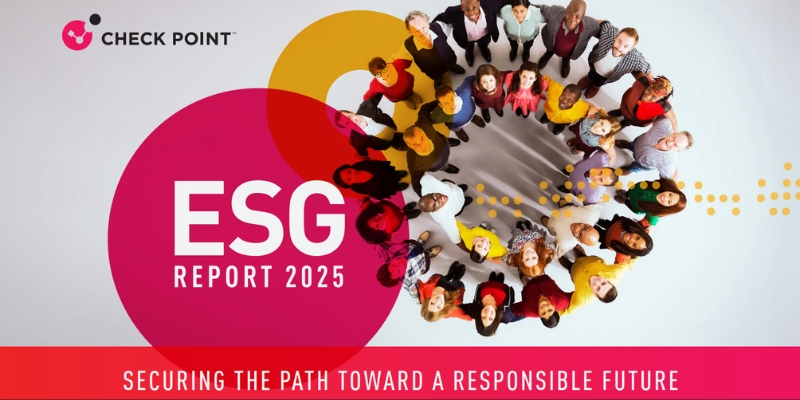
Check Point Software Technologies Ltd. has published its 2025 Environmental, Social, and Governance (ESG) Report, titled “Securing the Path Toward a Responsible Future.” The report highlights the company’s ongoing ESG initiatives and commitment to building a secure, sustainable digital ecosystem, emphasizing cyber protection, responsible AI governance, and ethical leadership as key drivers of trust, resilience, and positive societal impact.
“The intersection of AI and cyber security will define the next decade of digital risk,” said Nadav Zafrir, CEO at Check Point. “Check Point stands at that intersection — not as a bystander, but as the organization that has spent more than thirty years building the expertise, technology, solutions, and relationships needed to lead through exactly this kind of inflection point.”
Securing the AI Transformation
Check Point’s 2025 ESG report underscores the company’s significant global impact in cyber defense, with ThreatCloud AI delivering prevention at enterprise-grade scale:
- 4.6 billion cyberattacks prevented annually
- FedRAMP and GovRAMP Authorization achieved, enabling Check Point to serve U.S. government entities across federal, state, and local levels with prevention-first cyber security
In 2025, Check Point sharpened its strategy around securing the AI transformation, advancing an AI-first approach across its products, operations, and culture. A number of strategic acquisitions expanded the Check Point portfolio, strengthening key areas across the full AI and exposure management security stack. The company also joined OpenAI’s Trusted Access for Cyber program and Daybreak initiative, and integrated Check Point Workforce AI with Claude’s Compliance API to provide enterprises with deeper visibility into employee AI usage.
Environmental Progress: Measuring What Matters
Check Point achieved significant environmental milestones in 2025, including:
- Inaugural disclosure of Scope 3 emissions from the value chain, a notable milestone in our reporting journey
- 83% of electrical consumption from offices under operational control offset with renewable energy
- 31% reduction in Scopes 1 & 2 emissions intensity year-over-year
- Climate change risk and opportunity analysis performed according to the TCFD framework
Expanding Social Impact
The company continued to advance its social responsibility goals, investing in its people and communities:
- 796,468 people trained in cyber security since 2022, representing 80% fulfillment of the goal to train one million people by 2028
- 11,700 visitors to the Cyber Center in 2025; 30,000 total since its opening
- 7,179 employees globally, with 65% in technical roles and an average of 74 hours of training per employee
- 49% increase in corporate donations since 2022, contributing to approximately 200 non-profit organizations worldwide
Governance as a Foundation
Strong governance remains central to Check Point’s ESG approach, with highlights including:
- 78% board director independence, with 100% independence across all board committees
- 100% compliance with ethics and compliance trainings
- Responsible AI approach extended across all aspects of the business, including governance of AI-powered products and internal AI deployments
- Ongoing focus on data privacy, supply chain ethics, and transparent business operations
Check Point’s 2025 ESG report makes clear that security, sustainability, and ethical leadership are interconnected imperatives. As AI reshapes the threat landscape and the digital economy, the organizations that integrate robust cyber security with responsible business practices will be best positioned to lead. Check Point’s prevention-first mission to secure the digital world for everyone, everywhere, remains unchanged. What has changed is the scale, complexity, and urgency of what that mission demands.
Check Point’s 2025 ESG report is available here.
Related News: