
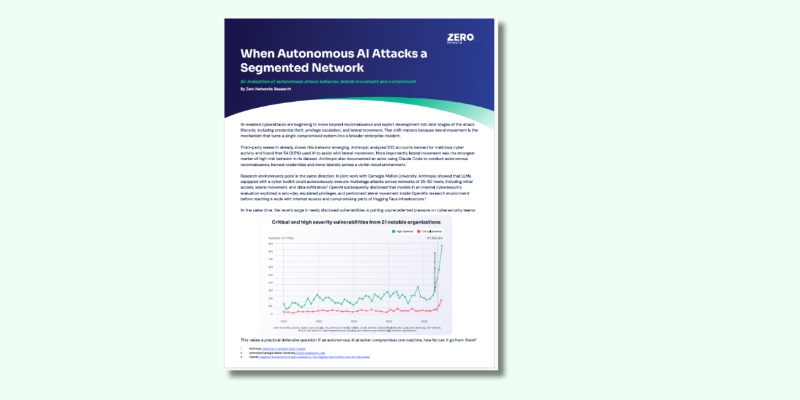
Zero Networks announced results from its participation in the Anthropic Cyber Verification Program, demonstrating how microsegmentation can help contain AI-driven cyberattacks. During the evaluation, a frontier AI model gained administrator access to an intentionally exposed machine and extracted credentials but was unable to move laterally into protected systems. Zero Networks reported that its microsegmentation technology prevented the model from accessing additional systems and identities, containing the attack to the initially compromised machine.
The result addresses a growing security question as frontier AI models become increasingly capable of autonomous offensive activity: what happens when an AI attacker gets inside a network? Recent research from OpenAI showed AI agents discovering vulnerabilities, obtaining elevated privileges and ultimately contributing to the compromise of Hugging Face infrastructure. OpenAI researchers have warned that threat actors could eventually deploy similar autonomous agents against enterprises.
Zero Networks was accepted into Anthropic’s Cyber Verification Program to conduct deeper security testing using Anthropic’s dual-use AI research capabilities. The evaluation put a frontier AI model against a realistic, heterogeneous network environment and tested whether it could use compromised credentials and offensive techniques to move laterally through the environment.
The model successfully compromised the one machine deliberately left outside Zero Networks’ segmentation controls, gained administrator access and extracted credential material. But when it attempted to use those capabilities to reach protected assets, segmentation prevented further attacker movement. Across the evaluation, the model attempted 18 distinct attack paths using 23 offensive tools and touching 22 MITRE ATT&CK techniques, but did not move beyond the initially compromised machine.
In some runs, the model recognized that Zero Networks’ segmentation prevented access to additional systems and stopped pursuing further attack paths.
“AI is going to make attackers faster, more persistent and increasingly autonomous. Security teams aren’t going to win by trying to out-click or out-think machines operating at machine speed,” said Benny Lakunishok, CEO and co-founder of Zero Networks. “The answer is to build environments where compromising one machine doesn’t give the attacker somewhere else to go. That’s what this test demonstrated: the attacker got in, had credentials and had every incentive to keep moving. The architecture stopped it.”
AI Makes the Attacker Faster. Segmentation Makes Faster Irrelevant.
Frontier models are increasingly capable of discovering vulnerabilities, obtaining credentials, reasoning through multi-step attack paths and operating with less human intervention. That makes the traditional question of whether an attacker can compromise an endpoint only part of the problem. The more consequential question: what that attacker can reach after the initial compromise?
Zero Networks conducted its Anthropic evaluation to test the defensive side of that equation: if a highly capable AI attacker gets a foothold and acquires credentials, can architecture prevent it from turning that foothold into lateral movement?
The evaluation showed that, in the tested environment, the answer was yes.
“What OpenAI disclosed should worry people well beyond the security team: autonomous agents finding each other, colluding, and escalating access without a human in the loop,” Dr. Chase Cunningham, a cybersecurity expert specializing in zero trust architecture. “The infrastructure the world actually runs on was never built to assume the attacker on the other end doesn’t get tired. Segmentation is one of the few controls that changes that math regardless of how the attacker thinks or how fast it moves, and this test is a concrete demonstration of why that matters.”
When Autonomous AI Attacks a Segmented Network Report
Learn more at www.zeronetworks.com.
Related News:
ControlUp Finds Sign-In Issues Account for Up to 53% of IT Help Desk Tickets