
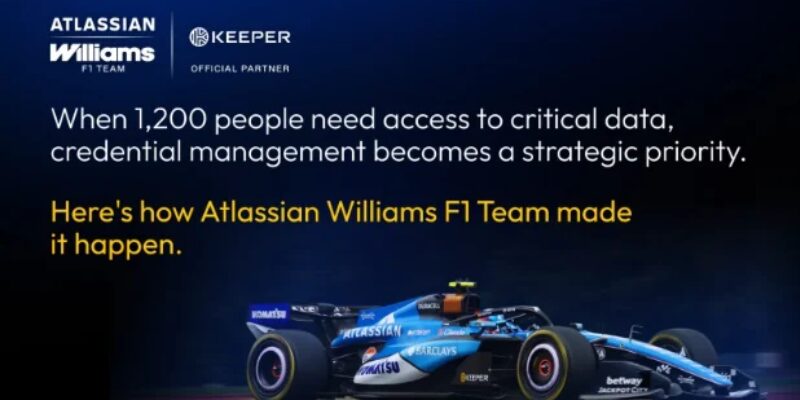
Keeper Security has released a new case study highlighting its partnership with the Atlassian Williams F1 Team. The study explains how Keeper safeguards the credentials protecting Williams’ critical racing data across a global workforce of 1,200 employees in more than 20 countries each season. During every race weekend, Williams produces over one terabyte of telemetry, aerodynamic and simulation data. More than 400 sensors installed on each FW48 race car transmit real-time information across 30,000 data channels to engineers at the track and the team’s headquarters in Grove, Oxfordshire.
In this high-profile, competitive sport, the credentials protecting access to Formula 1 data carry the same strategic value as the data itself. Williams uses Keeper Enterprise Password Manager alongside Keeper’s BreachWatch dark web monitoring to centralize credential management across engineering, IT, race operations, travel and marketing functions, replacing the spreadsheets, chat messages and informal workarounds that many organizations still rely on to share sensitive access.
“Many organizations treat credential management as a compliance problem they hand off to a vendor, which leads to security becoming friction,” said Darren Guccione, CEO and Co-founder, Keeper Security. “Williams understands they must treat credentials as foundational infrastructure, so security stops being a bottleneck and becomes the foundation that enables speed.”
Keeper’s zero-knowledge architecture means the user’s device generates encryption keys that never reside on Keeper’s servers. Elliptic-curve cryptography, AES-256-bit encryption and Password-Based Key Derivation Function 2 (PBKDF2) provide protection at the vault, folder and record levels, with multi-factor and biometric authentication enforced throughout. Keeper also layers in Kyber, a quantum-resistant encryption algorithm approved by the National Institute of Standards and Technology (NIST), addressing “harvest now, decrypt later” attacks in which adversaries collect encrypted data today with the intention of decrypting it once quantum computing matures.
“F1 is a team sport. Without all the teams working together on the same task, nothing works. We don’t want security to be the blocker. People need to access what they need, when they need it,” said Chris Hicks, Senior Information Security Engineer at Atlassian Williams F1 Team. “With F1, you’ve always got to be thinking about the next race, the next upgrade path, the next regulation cycle. So it’s great to see that Keeper Security is already taking that same philosophy and thinking down the line about how we can protect ourselves from what we know is coming next.”
Beyond encryption, Keeper’s shared folders and role-based permissions enable Williams to automatically provision personnel with the exact credentials they need, while One-Time Share gives contractors and third parties time-limited access that expires without manual intervention. Williams personnel in roles from guest experience to travel administration and cost engineering point to the same benefit: a single, organized place to manage every credential they rely on, accessible consistently whether the team is at Grove or trackside on the other side of the world.
Today, Williams employees use Keeper to manage more than 17,000 credentials across factory and race departments. Access to multiple credentials can be provisioned in seconds through group-based controls. Whether at a race event, a test session or Grove during the off-season, Keeper operates consistently wherever Williams’ race IT kit is deployed. From factory floor to pit lane, Keeper provides a consistent, secure way to manage the credentials that keep the team moving forward.
Read the full Atlassian Williams F1 Team and Keeper Security case study for more details here.
Related News:
Self-Managed Keeper Secures Critical Infrastructure with Zero-Trust PAM