
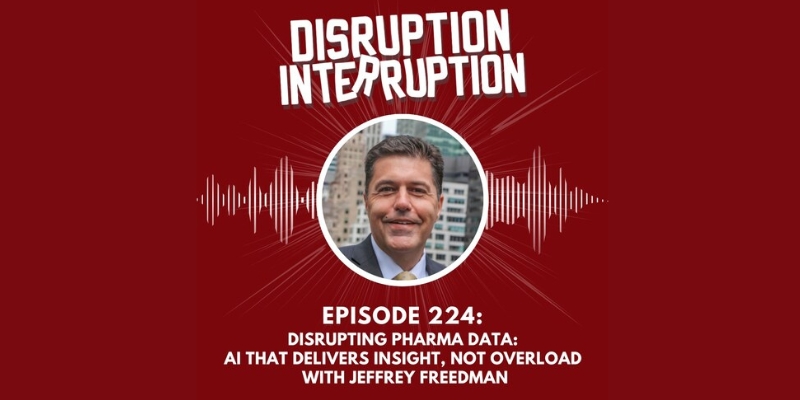
Pharma is flooded with data yet still lacks actionable insight. In this episode of the Disruption Interruption podcast, Jeffrey Freedman, Executive Vice President at Evolution Health Group, joins host Karla Jo Helms (KJ) to explore why the industry continues to struggle to connect doctors, patients, and meaningful medical education, even as AI starts improving diagnostic precision and cutting through the noise.
As Jeffrey Freedman puts it, “Pharma and medical industry itself is data rich, but insights poor.” His view is that the real shift is not the amount of information available, but the industry’s growing ability to extract usable insight and turn it into faster, more informed action.
Why the Industry Still Struggles to Connect the Dots
Massive streams of interaction data, research signals, physician engagement, patient behavior, and market feedback have existed for years, but without the appropriate tools, extracting useful meaning from them has been painfully slow. The data kept growing; the insight did not.
A major part of the problem is fragmentation. Freedman notes that pharmaceutical companies have historically operated across disconnected spreadsheets, regions, teams, and data sets, creating information loss and making global coordination difficult. He diagnoses it bluntly: when employees work off separate spreadsheets and siloed data, “stuff gets lost, right? Stuff isn’t integrated. You don’t know what is happening on the other side of the world.”
Freedman also pushes on a more controversial practice in pharma: the industry’s reliance on direct-to-consumer marketing. He argues that too much money still goes toward patient-facing advertising and not enough toward educating physicians. “I personally believe that a lot more budgets need to be spent on educating physicians,” he says. “We don’t want patients all the time coming to a doctor and saying, ‘I need a GLP-1.’ I want the doctor saying to a patient, ‘You have these issues, let’s talk about how to make you better.'” The bigger issue is not visibility alone, but whether the right medical education is reaching the right people in time to improve patient outcomes.
A Remedy for Pharma’s Insight Deficit
Freedman’s prescription is not more data, but better systems for converting data into action. “You have to know how to ask the right questions,” he says, arguing that AI becomes useful when it helps teams identify the proper physicians, key opinion leaders, institutions, and signals, before turning those findings into the next best action.
That same logic shapes how he sees the future of care. Freedman argues that better insight and faster communication can help move products from bench to bedside more quickly and more affordably, including therapies for rare diseases that were once too expensive to pursue. “We want the cost of medicine to go down,” he says. For him, better technology should reduce noise, accelerate learning, and help doctors make more informed decisions for the patients in front of them.
At Evolution Health Group, that vision shows up in the platforms his team is building. Freedman describes the company as an “insight generation company,” with tools designed to identify key opinion leaders, aggregate scattered brand and field data into a single source of truth and monitor digital conversations to help pharma understand what matters and who matters.
Through platforms like 360 Connects, 360 KOL, AIM, and its social-listening tools, the company is working to close the communication gap between brands, physicians, and patients. And, in Freedman’s view, that work starts with correcting a bigger misconception about the industry itself: “Pharma is not this big scary monster that’s put out there in the media. It’s a bunch of people that really care.”
Disruption Interruption is the podcast where you will hear from today’s biggest Industry Disruptors. Learn what motivated them to bring about innovation and how they overcame opposition to adoption.
Related News:
Colin Cooper Disrupts the 200 Year Old Education System Factory Model