
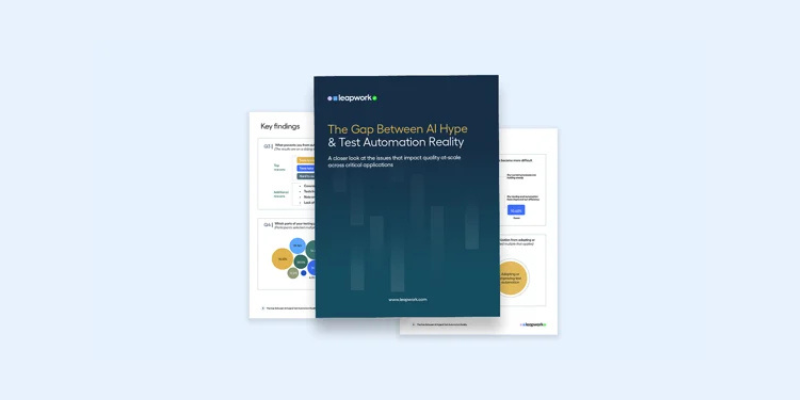
Leapwork announced the findings of a new study exploring how software teams are adopting AI in testing and the key factors that influence their confidence in using it. The research takes a closer look at how organizations evaluate AI-driven testing tools, what challenges they encounter, and how considerations such as accuracy, reliability, and required oversight shape overall trust in these technologies.
The study shows broad optimism about AI in testing, with most organizations now viewing it as a priority in their future testing strategy. At the same time, the findings highlight a clear reality for teams responsible for quality across critical systems: confidence in AI-driven testing depends on accuracy, reliability, and the ability to keep tests current as applications evolve.
Testing places unique demands on AI. Errors carry real business risk, and fragile tests or slow updates can quickly erode trust in results. As a result, while momentum around AI in testing is strong, many teams apply it carefully, guided by the maturity and stability of their existing automation.
Leapwork’s study gathered responses from more than 300 software engineers, QA leaders, and IT decision makers at large and midsize organizations worldwide. Key findings include:
Strong AI momentum in testing
-
88% of respondents said AI is a priority for their organization’s future testing strategy, with 46% rating it as critical or high priority
-
80% said AI will have a positive impact on testing over the next two years
-
65% said they currently use or explore AI across one or more testing activities, though only 12.6% use AI across key test workflows today
Accuracy and stability shape confidence
-
54% cited concerns about accuracy and quality as factors that hold back broader use of AI in testing
-
Tests that break too often, difficulty automating flows across systems, and the time required to update tests ranked as the top reasons teams struggle to automate more testing
-
45% said it takes three days or more to update tests after a change in a critical system
Manual effort remains a major constraint
-
On average, only 41% of testing is automated today
-
71% said test creation slows their teams down the most, followed by test maintenance at 56%
-
54% cited lack of time as a barrier to adopting or improving test automation
“It is no longer a question of whether testing teams will leverage agentic capabilities in their work. The question is how confidently and predictably they can rely on it,” said Kenneth Ziegler, CEO of Leapwork. “Our research shows teams want AI to help them move faster, expand coverage, and reduce effort, but accuracy remains table stakes. The real opportunity lies in applying and integrating AI alongside stable automation, so teams gain speed and scale without sacrificing trust in outcomes.”
The findings point to a clear opportunity for organizations expanding AI use in testing. Teams that pair AI capabilities with strong, reliable automation foundations are better positioned to scale testing with confidence as systems evolve.
To view the Leapwork 2026 AI in Testing Automation Study, click here.
Related News:
Bugcrowd Acquires Mayhem Security to Advance AI-Driven Security Testing
State of Digital Quality Report 2025: AI Testing Has Doubled In 2025