

The digital advertising industry is poised for a major shift in 2026. According to the latest eMarketer forecast, Meta is expected to surpass Google in total digital ad revenue by year’s end, both globally and in the U.S. With accelerating growth, Meta is projected to lead not only in revenue but also in overall market share, becoming the dominant force in digital advertising.
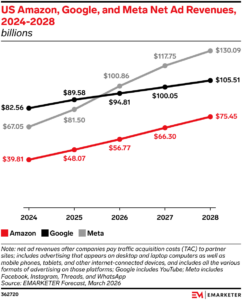
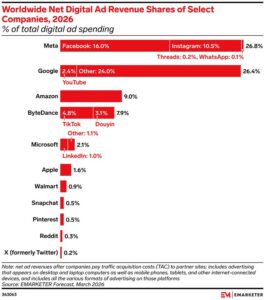
Meta is forecast to reach $243.46 billion in net worldwide ad revenues in 2026, with Google reaching $239.54 billion. Last year, Google was ahead, with $214.06 billion and Meta with $196.17 billion*. In terms of share, Google still controls more than a quarter of global ad spend (26.4%). But while its share has been falling since 2021, Meta’s share has grown, and will overtake Google this year with 26.8% of worldwide ad spend.
“In surpassing Google, Meta has essentially had many of its core strategies validated,” said Max Willens, principal analyst at Emarketer. “Meta has long understood that scale, network effects, and habits are more important than anything else in digital media. It has carefully built and defended the advantages it has in all three areas.”
The reason for the shift? Meta is growing at an unprecedented rate for a company of its scale. Its worldwide growth rate will accelerate from 22.1% in 2025 to 24.1% in 2026. Conversely, Google’s growth rate will remain steady at 11.9% this year.
“Meta’s growth is not coming from just one source,” said Zach Goldner, senior forecasting analyst at Emarketer. “Instead, it’s unlocking more value across its entire ecosystem at the same time. Tools like its Advantage+, AI-generated ad creatives, and its broader automation stack are improving performance across both Facebook and Instagram, with Reels being a big beneficiary. As a result, advertisers are getting better bang for their buck, and that’s pulling more ad dollars onto the platform.”
“For the vast majority of advertisers, the question is not whether they should spend money on Meta’s apps—the question is how much they should spend,” Willens said.
“Google has plenty of levers it can pull to try to speed up growth,” Willens said. “But the diversity of its business—it generates billions of dollars in subscriber revenues from YouTube Premium, for example—may make it harder for it to leapfrog past Meta in terms of digital ad revenues.”
It’s important to note that while this forecast was completed just prior to the court rulings against Meta and YouTube, we do not think the verdicts will have a material impact on our figures.
“These cases will take years to fully play out through appeals and additional trials, and they don’t immediately force changes to how these platforms operate today,” Goldner said. “More importantly, advertisers don’t reallocate billions of dollars based on legal risk, they follow performance, and that is the bigger driver behind the shifting balance between Meta and Google.”
Meanwhile, No. 3 player Amazon earned $68.64 billion in worldwide ad revenues in 2025, and it will grow to $82.07 billion in 2026 and $97.07 billion in 2027. Amazon’s share of global digital ad spending will reach 9.0% in 2026, up from 8.0% in 2024.
Taken together, the three platforms will represent 62.3% of total worldwide digital ad spending in 2026 and will increase that share slightly through 2028.
“The consolidation of digital ad dollars around Google, Meta, and Amazon reflects a compounding advantage of first-party data, AI integrations, and audience reach,” said Drew Spink, senior forecasting analyst at Emarketer. “Smaller platforms and traditional media can’t replicate these capabilities in comparable cost or speed and, as a result, incremental budgets continue to flow in that direction.”
* These figures reflect all properties within the umbrella companies,
Related Posts:
2026 CISO Survey: 73% Unprepared for Next Cyber Attack
Top 10 File and Object Storage Platforms
Methodology
EMARKETER forecasts and estimates are based on our proprietary analysis and include both quantitative and qualitative data curated from public companies, government agencies, research and media firms, and interviews with expert executives in relevant fields. We regularly re-evaluate available data to ensure our forecasts reflect the latest business and economic developments and trends.