
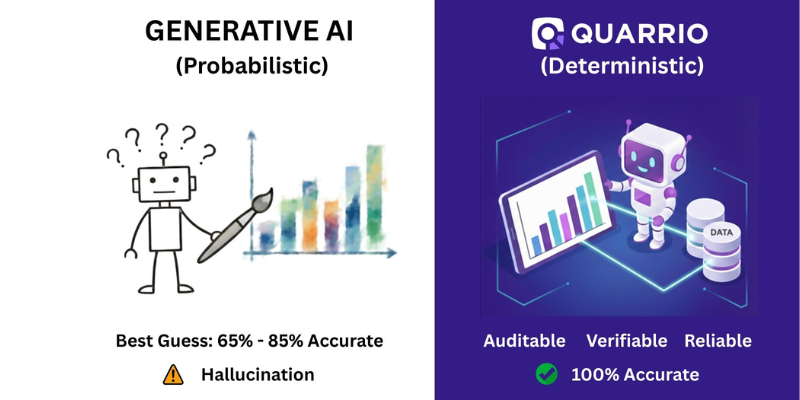
As enterprises invest billions in generative AI with limited measurable returns, Quarrio has introduced its Deterministic AI Platform, an infrastructure layer purpose-built for the next stage of enterprise AI, focused on delivering accurate, consistent, and auditable execution.
According to MIT NANDA’s The GenAI Divide: State of AI in Business 2025 report, despite $30-40 billion in enterprise investment in generative AI, 95% of organizations report seeing little to no material ROI. Reuters has similarly reported that many companies are still struggling to translate AI deployments into measurable business value, with some pushing expectations and spending further into 2026 and beyond. At the same time, enterprises continue to face information latency as critical reporting and decision support can still take days or weeks to assemble from structured systems.
“AI is moving from conversation to control,” said KG Charles-Harris, CEO of Quarrio. “Once AI systems start approving transactions, triggering capital allocations, or executing workflows, enterprises cannot tolerate the probability-driven guesswork of GenAI. The future belongs to AI that can prove what it did and why.”
The Trust Gap in Enterprise AI
Most AI deployed in enterprises today is probability driven. Large language models (LLMs) generate likely answers to chat prompts based on statistical patterns. While that process may be acceptable in creative tasks, it cannot provide the accuracy required in regulated, financial, or operational decision-making.
That reliability gap is increasingly being acknowledged by the enterprise software incumbents themselves. In a December 2025 analysis of Salesforce’s AI strategy shift, company leaders showed declining confidence in LLM reliability and were emphasizing more deterministic controls to reduce model randomness in business-critical workflows.
As enterprise technology unwittingly expands AI risks, and with agentic models becoming more autonomous and taking on complex work once handled by humans, the need for certainty must keep pace as governance risk intensifies. Yet most enterprise systems still lack a deterministic execution layer.
Quarrio’s platform introduces one.
Same Input, Same Output
Unlike probability-driven GenAI, Quarrio’s architecture translates natural language into verified database queries against structured enterprise systems such as CRM, ERP, financial systems, and risk databases. Deterministic AI provides full query transparency and consistency:
- If the data exists, it retrieves it.
- If it does not exist, it says so.
- If the same question is asked twice, the same answer is returned.
Quarrio is built to ensure output includes traceable logic that enables independent verification and audit trails.
“Enterprises don’t need more AI that sounds intelligent,” Charles-Harris said. “They need AI that behaves like infrastructure that can be trusted and depended on.”
Why This Matters Now
Enterprise AI adoption is accelerating while infrastructure strain grows:
- Global AI spending is projected to exceed $300 billion annually within the next few years, according to IDC projections.
- GPU shortages and rising compute costs continue to constrain deployment.
- Regulatory scrutiny of AI decision systems is increasing across financial and healthcare sectors.
- Companies are facing mounting litigation over data training practices and content usage.
Quarrio’s deterministic model operates on existing enterprise infrastructure, reducing GPU dependency and eliminating the need to export or retrain on sensitive customer data. The company’s soon to launch SDK allows developers to build deterministic agents-enabling enterprises to pair probability-driven language interfaces with verifiable execution-level logic beneath them.
From Business Intelligence to Operational Infrastructure
Traditional business intelligence tools rely on analyst queues, dashboards, and manual reconciliation. Quarrio collapses the cycle time from information to action. By reducing report latency from weeks to seconds, organizations gain:
- Instant answers and analytics from structured and semi-structured data sources
- Unified data across the enterprise, incl. CRM and ERP data in real time
- Automated monitoring and alerts on compliance thresholds
- Workflow triggers with audit trails
Quarrio provides a deterministic execution layer for the enterprise stack. For example, this means enterprises can detect margin erosion or risk exposure instantly and immediately identify causes and automatically enact auditable resolutions.
“AI is no longer being used as a feature or a tool; it’s becoming core infrastructure,” Charles-Harris said. “And infrastructure must be governed, measurable, and trusted. Enterprises cannot run their business operations on prompts and probability.”
Related News:
EmberOT Releases OT PCAP Analyzer v2.0.4 with Enhanced Asset Fidelity
WaveMaker Launches Agentic Application Generation System for Enterprise Devs
References
- Challapally, A., Pease, C., Raskar, R., & Chari, P. (2025, July). The GenAI divide: State of AI in business 2025 (Report). MIT NANDA (Project NANDA).
- Seetharaman, D., Mukherjee, S., & Hu, K. (2025, December 16). AI promised a revolution. Companies are still waiting. Reuters.
- Cutter, C. (2025, April 18). Johnson & Johnson pivots its AI strategy. The Wall Street Journal.
- Abraham, J. (2025, December 22). Salesforce just admitted what enterprise buyers already suspected about LLMs. ThoughtCred.