
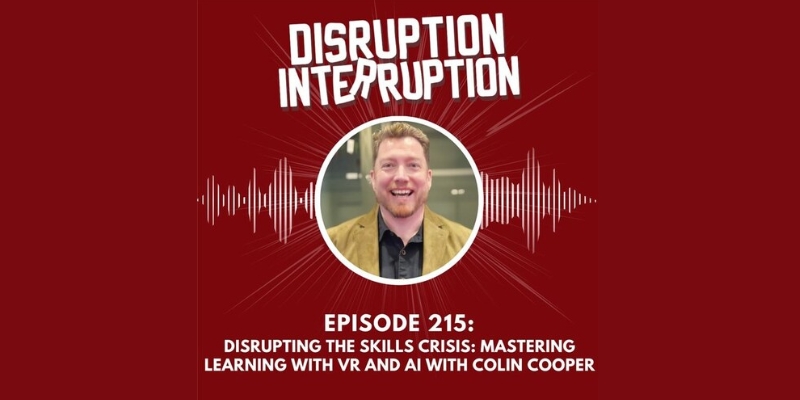
A recent Cengage Group report found that only 30% of 2025 college graduates secured entry-level jobs in their fields, while Georgetown University projects a shortage of 5.25 million workers with post-secondary training by 2032. As the skills gap grows and the economy becomes increasingly AI-driven, traditional education is struggling to keep up. On the Disruption Interruption podcast, Illuminate XR CEO and co-founder Colin Cooper joins host Karla Jo Helms to discuss breaking away from the outdated factory-style learning model, arguing immersive technology is essential for preparing workers for the “age of humanity.”
“We have one opportunity to do this now. In 20 to 25 years, we’re going to look back and ask, ‘Wow, didn’t we nail that?’ or ‘Wow, we completely screwed that up,'” says Cooper. “I want to be on the side of improving education because we have the power and technology to do that on a global scale.”
The Education System Is 200 Years Behind
The current educational framework operates on an industrial-age factory model established nearly two centuries ago. Designed to produce compliant workers for a world that no longer exists, this system relies on standardization rather than individualization. Cooper points out that while technology accelerates—compressing 20 years of progress into a single year—the fundamental way humans are taught remains stagnant, creating a critical disconnect between school curriculums and workforce requirements.
“Most of the education systems out there are training children to learn for a world that no longer exists—essentially the industrial age,” explains Cooper. “The fundamental part of the curriculum is close to 200 years old. Classrooms themselves haven’t really changed in design in over a thousand years.”
Cooper notes that this stagnation forces businesses to bear the burden of retraining. “One of my biggest frustrations with hiring in businesses was getting people that you had to un-educate to re-educate them into what you needed. That is expensive and a big challenge.”
Meeting Learners Where They Are
Illuminate XR addresses this crisis by leveraging AI and VR to create personalized, immersive learning experiences. By meeting learners where they are—whether tailoring physics lessons to sports interests or using VR for public speaking practice—the platform reduces cortisol and increases dopamine to ensure retention. Cooper emphasizes that AI should not replace teachers but amplify human potential by handling repetitive tasks and offering unique scaffolding for every student.
“Real learning happens when you reduce cortisol and increase dopamine by connecting education to personal interests,” says Cooper. “If you are meeting someone where they are at, they feel an instant connection to you. That’s where real learning happens.”
Cooper concludes with a vision for the future of the classroom: “We don’t want to be replacing teachers. What we need to do is use technology like AI to amplify the teacher in the room. If you’ve got 30 kids, you could have 30 teaching assistants unique for that child.”
To learn more, listen to the full Disruption Interruption episode on the future of the education system with Colin Cooper here.
Related News:
Micah Remley: Using Data to End Hybrid Work Chaos
Keysight Advances 6G@UT Digital Twin Research
Disruption Interruption is the podcast where you will hear from today’s biggest Industry Disruptors. Learn what motivated them to bring about innovation and how they overcame opposition to adoption.
Disruption Interruption can be listened to in Apple’s App Store and Spotify.
References
- Nietzel, M. T. (2025, September 10). As skills gap grows, job market for college grads hits 5-year low. Forbes. forbes.com/sites/michaeltnietzel/2025/09/10/new-report-as-skills-gap-grows-job-market-for-college-grads-at-5-year-low/