
DeepKeep provides end-to-end AI security and trustworthiness across the full AI lifecycle. Its platform protects multimodal systems – including large language models and computer vision – helping enterprises deploy and use AI safely, accurately, and in compliance with security and privacy standards. With capabilities such as an AI Firewall, Vibe, and Automated AI Red Teaming, AI Usage Control, and advanced Model Scanning operating across applications, agents, and users, DeepKeep enables cybersecurity teams to defend against vulnerabilities, data leakage, hallucinations, and bias while maintaining trust in AI-driven operations. Founded in 2021 by a team of cybersecurity experts, DeepKeep is dedicated to securing the future of enterprise AI.
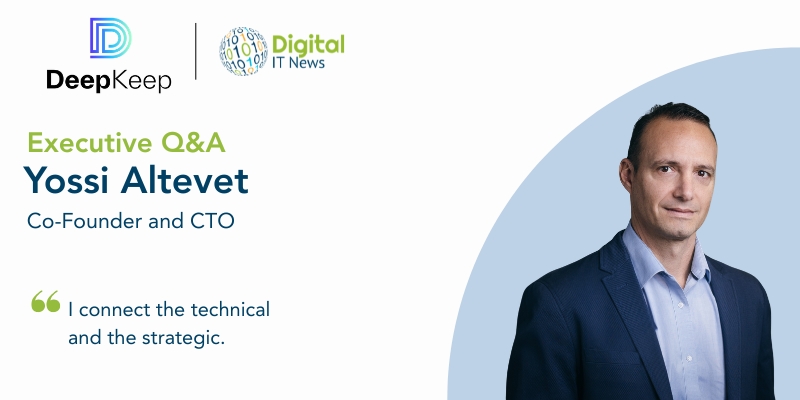
Yossi Altevet is Co-Founder and CTO of DeepKeep. He brings over two decades of experience across technology-driven innovation, spanning network infrastructure, telecommunications, and AI systems. Prior to DeepKeep, Yossi held senior product and innovation roles at Cisco, Comverse, DriveU.auto, and more, where he led AI-focused projects and developed deep expertise in next-generation networks and machine learning.
Yossi co-founded DeepKeep in 2021 alongside Rony Ohayon and a team of cybersecurity experts, building the company from a computer vision security tool into a comprehensive platform covering AI agents, LLMs, multimodal systems, and the full AI application ecosystem.
Career Journey: Can you share the most interesting story that happened to you since you started your career, especially one that shaped your leadership approach at your current company?
When I worked to build AI systems for autonomous vehicles earlier in my career, it became clear that the gap between a model performing well in a controlled test environment and the same model behaving unexpectedly in the real world is not just an engineering problem, but a genuine safety problem, and no one had a systematic way to close it.
This experience taught me to build teams who are skeptical of their own systems, always scrutinizing and second-guessing to ensure the most reliable results. At DeepKeep, this mindset is central to everything we do, as we must find all failure possibilities before they find our customers.
Career Path: What initially brought you to this specific career path, and how did it lead to your role in this company?
The thread running through my career has always been working where emerging technology meets high-stakes systems, where failure has real consequences. From autonomous vehicles to enterprise AI, I am drawn to moments where the gap between how a system performs in a lab and how it behaves in the real world is not just an engineering problem – it is a safety and security problem that impacts real people, their business, and their data.
When Rony, the founder of DeepKeep, and I were looking at the enterprise AI landscape in 2021, the pattern was clear. Businesses were adopting AI at a rapid pace, but the security approach had not evolved at all. Organizations were relying on traditional cybersecurity tools that were never designed to account for how AI systems behave when interacting with data, users, and other AI models. We understood that the gap was about to become a serious problem, and directly led us to found DeepKeep.
Company Differentiation: What makes your company stand out from competitors in the market? Can you share an example that highlights this?
Most AI security tools address one layer of the problem. They scan a model, or they add a guardrail, or they test a chatbot. What they do not do is provide connected security with shared context and policy enforcement across the entire AI lifecycle, from development through deployment and into continuous operation.
DeepKeep provides end-to-end AI security coverage where, unlike disparate point solutions, every component of the platform shares context. Model Scanning, Vibe or Automated Red Teaming, AI Firewalls, Usage Control, our AI Agent Scanner, and more all operate with awareness of the specific environment and application they are protecting.
This means, for example, that a vulnerability identified during red teaming directly informs the guardrails applied at runtime – so security intelligence compounds across the platform rather than sitting in isolated tools. Enterprise AI risk is highly contextual, and a one-size-fits-all approach misses vulnerabilities that only emerge when a model is connected to real data and real workflows.
Furthermore, we strategically decided to target both the European and Asian markets and consequently developed our solution to deliver native multilingual coverage. It essentially means our detection accuracy and latency remains intact across any language.
For example, we had an enterprise running a generative AI customer support application that interacted with sensitive internal systems. Their existing security controls could not inspect or govern model behavior in real time, which was blocking them from going to full production.
We deployed our AI firewall within their LLM workflows, and it inspected every prompt and response, blocked malicious inputs, prevented PII exposure, and enforced compliance guardrails without impacting performance. They moved from a limited pilot to full production, and leadership approved broader AI rollout as a direct result. That is the outcome we are building toward: security that enables AI adoption rather than slowing it down.
Product Innovation: Are you working on any exciting new products or projects? How do you think this innovation will positively impact your customers?
One area we are very focused on is agentic AI security. Autonomous AI agents represent a fundamentally different risk surface compared to traditional AI applications. Agents do not just respond to static prompts – they can autonomously initiate tasks and business decisions, access file systems, interact with operational databases, and increasingly communicate with other agents, and the attack surface is only getting larger.
We designed our AI Agent Scanner to give security teams structured visibility into that surface for the first time. It maps the full threat landscape of each agent, including connected tools, data sources, and potential vulnerabilities, and produces a visual risk map that security teams can review and act on.
We have also recently released an exciting Vibe AI Red Teaming capability that approaches AI red teaming in a different way. It brings human-in-the-loop guidance to AI red teaming and dramatically reduces the time and expertise required to test AI applications comprehensively.
Traditional automated red teaming is powerful, but it still requires significant security expertise to configure, interpret, and act on, while following a script of tests designed to provide coverage. Vibe AI Red Teaming changes that by bringing more control into the hands of the security team, lowering the barrier to comprehensive AI testing without requiring deep adversarial expertise to do it.
The impact for customers is concrete: faster time to secure deployment, broader test coverage without growing headcount, and the ability to keep pace with AI systems that are evolving faster than traditional security approaches can follow.
Success Insight: What was the tipping point for your company’s recent success? Was there a change in strategy or approach that others might learn from?
The clearest tipping point was the decision to move beyond securing foundational models and focus on securing entire AI ecosystems. We made the case, and eventually the market caught up, that the real risks emerge not from a model in isolation, but from what happens when that model is connected to internal systems, sensitive data, and operational workflows. Shifting our platform strategy around that insight was what positioned us ahead of where enterprise demand was heading.
The lesson for others is to resist the temptation to build around where enterprise buyers are today. In a market moving as fast as AI, the companies that will lead are the ones that build around where the risk is actually heading, and then make the case clearly enough that customers can see it too. For us, that meant treating AI security as an ecosystem problem before most of the market was ready to frame it that way.
Challenges and Lessons: Can you share a significant challenge your company faced and how you overcame it? What key lesson did that experience provide?
The early conversation around AI risk was dominated by ethics and bias, which was a challenge. The idea that an enterprise AI application needed its own security infrastructure, distinct from traditional cybersecurity, was not yet intuitive to most buyers.
We overcame this by going in depth with early customers and letting their pain points drive the roadmap. Customers in sensitive environments, such as financial services and healthcare, were already experiencing issues and did not need to be convinced that there was a problem. We validated our direction through those conversations rather than waiting for the market to catch up.
The lesson is more specific than timing alone. In an emerging market, regulated industries carry the signal. Financial services and healthcare customers were already experiencing the pain that the broader market would eventually recognize, and building around their real-world requirements gave us both validation and a roadmap that was grounded in actual enterprise need rather than speculation. That approach is what got DeepKeep to where we are today.
Leadership Impact: In just a few words, what differentiates your leadership role from others in the company? What impact does this have on company culture or product success?
I connect the technical and the strategic. My role is to translate complex, fast-moving AI threats into product decisions that are coherent, scalable, and ahead of where the market is heading so the team stays focused on what genuinely matters rather than reacting to every new development as it emerges.
That clarity shapes the culture as much as the product. When the threat landscape is this dynamic, the difference between a reactive team and a focused one is everything.
Learn more about DeepKeep here.
Related News:
Netwrix Data and Identity Report Reveals Gaps in AI Security Readiness
Black Duck State of AI-Powered Software Development Report Released