
Tuskira has introduced an autonomous red teaming capability that uses AI agents to identify exploitable attack surfaces by simulating external attacker behavior. The technology validates findings against an organization’s existing security controls, reported internal risks, and application and infrastructure architecture. By evaluating vulnerabilities, identities, and control configurations together, Tuskira aims to help security teams prioritize exposures that attackers could actually exploit.
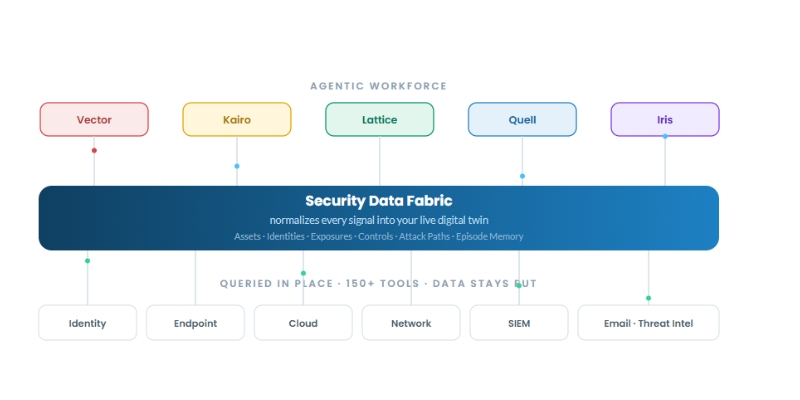
Tuskira’s Red Team Agent probes customer-approved external scope using emerging tactics, techniques, and procedures (TTPs), newly disclosed vulnerabilities, and AI-driven attack techniques. Rather than stopping at “exposed,” it uses Tuskira’s Security Data Fabric as context. The fabric normalizes signals from third-party security tools into a live digital twin of the enterprise, covering security architecture, application and infrastructure topologies, deployed controls, and the risks those controls already report.
Grounding adversarial testing in the enterprise’s own architecture lets Tuskira validate exposure at machine speed without blind exploitation against production systems.
With this release, security teams can:
- See what attackers see: Discover the internet-facing assets, services, identities, and misconfigurations an attacker can reach across cloud, identity, endpoint, network, and on-prem environments, within customer-approved scope.
- Eliminate false positives: Confirm whether each finding is truly exploitable by checking it against deployed compensating controls, internal risk context, and application and infrastructure topology.
- Validate exposure autonomously: Run continuous adversarial validation of existing vulnerabilities, identities, and control configurations, replacing manual triage and waiting for the next scheduled engagement.
- Accelerate investigation and containment: Reduce the time it takes to validate an exposure, and hand investigators the validated attack path with asset, identity, and blast-radius context already attached.
- Reduce dependence on patching: Recommend or stage the highest-leverage change to controls the organization already owns, such as a WAF rule, firewall policy, IAM restriction, or EDR setting, then re-test to confirm the path is closed.
“Every organization has a list of what’s exposed. What they don’t have is a trustworthy answer to whether an attacker can actually get in, and what already stands in the way,” said Piyush Sharma, CEO and Co-founder of Tuskira. “Our Red Team Agent tests from the outside the way an attacker would, then checks that answer against everything the enterprise knows about itself: its architecture, its controls, and the risks its tools are already reporting. That is how we remove the noise, and it’s why the fix is often a control change a team can make today instead of a patch that waits for the next maintenance window.”
From Breach Modeling to Continuous Cyber Defense
Kairo was introduced in May 2026 to uncover deep, cross-domain breach paths and validate them against existing security controls. Today’s release extends that foundation in two ways: red team sensors that keep the digital twin’s threat picture current without waiting on a scheduled engagement, and an agentic defense loop that carries what the sensors find through prioritization, investigation, and response, then verifies the result.
Each Tuskira agent plays its part on that shared model: Kairo maps cross-domain attack paths, Lattice validates which exposures are exploitable and worth fixing first, Quell answers whether a newly disclosed CVE creates a reachable path, and Iris investigates alerts with the same asset, identity, and blast-radius context.
In Tuskira deployments, Kairo has deprioritized up to 99% of scanner findings as unreachable and recomputed breach-path maps in minutes as environments change, allowing SecOps teams to focus on the smaller set of exposures that remain exploitable, insufficiently detected or insufficiently controlled.
To learn more, visit: https://www.tuskira.ai/
Related News:
HP Threat Report: Cybercriminals Target Crypto Wallets with Agentic AI
Black Kite’s Manufacturing & Distribution Ransomware Report 2026 Released