
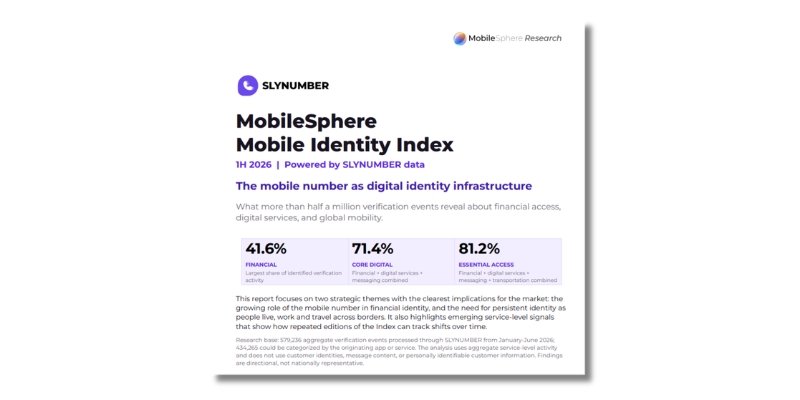
MobileSphere has released its Mobile Identity Index for the first half of 2026, highlighting the expanding role of mobile numbers as digital identity credentials. Beyond communications, phone numbers are increasingly used to verify access to banking, payments, technology platforms, messaging services, and other digital services. The report found that financial services represent 41.6% of identified verification activity, while messaging and global mobility are also contributing to increased mobile identity use.
Powered by SLYNUMBER data, the research analyzes more than half a million aggregate and anonymized mobile verification events from January through June 2026.
Financial services accounted for 41.6% of identified verification activity, more than twice the share of any other single vertical. Digital services, including platforms such as Google, Microsoft and AI services, represented 18.8%, while messaging accounted for 11.0%. Together, financial services, digital services, and messaging apps represented 71.4% of identified activity, rising to 81.2% when transportation was included.
The findings show the mobile number functioning as more than a way to call or text. It is increasingly part of the identity layer consumers use to access money, activate digital services, communicate, recover accounts, and stay connected across devices, networks, and locations.
“The mobile number has quietly become a critical part of our digital life,” said Toufic Mobarak, founder and President of MobileSphere. “We depend on it to access our money, communicate, activate social and messaging apps, recover accounts, and confirm our identity. That role becomes even more critical when people travel, relocate, or live across borders.”
Financial services emerge as the leading mobile identity use case
Financial services led the identified verification mix across the first half and gained 9.7 percentage points in share from the beginning to the end of the period. Activity spanned banks, payment services, bank-linking platforms, credit products, and cash-flow tools, reinforcing how deeply the mobile number is embedded in financial authentication, account access, and customer continuity.
Additional Findings:
- Messaging gained share. Messaging represented 11.0% of identified activity across the half and increased 4.4 percentage points, with higher aggregate activity across several international messaging services during major travel periods.
- Mobile identity moves with consumers. Aggregate verification activity shifted around tax season, major travel periods, and global events, showing how aggregate demand for access to financial, communications, and mobility services can change alongside real-world events.
- Connectivity and identity are different layers. For travelers and expatriates, eSIMs, roaming plans, Wi-Fi, and hotspots can provide connectivity, but continued access to a recognized mobile number may still matter for banking, payments, messaging, and account recovery.
- Mobile identity is concentrated in essential digital services. Financial services, technology, and messaging accounted for 71.4% of identified activity, rising to 81.2% when transportation was included.
- Emerging service trends are visible. AI services and international messaging produced some of the strongest growth signals in aggregate verification activity during the half, with OpenAI-related activity reaching record levels in May and June and multiple messaging services reaching record or near-record levels during major travel periods.
By tracking aggregate verification activity over time, the Mobile Identity Index is designed to detect emerging shifts in the digital services consumers rely on for identity and access. This report highlights these trends to underscore the critical importance of user digital identity.
To download the full 1H 2026 report, visit:
https://slynumber.com/docs/MobileSphere_Mobile_Identity_Index_1H2026_Research_Report.pdf
Visit https://www2.mobile-sphere.com/ for more information.
Related News:
Tuskira Launches Autonomous Red Teaming for Exposure Validation
HYPR Research Finds 98% of HR Executives Encounter Candidate Fraud