
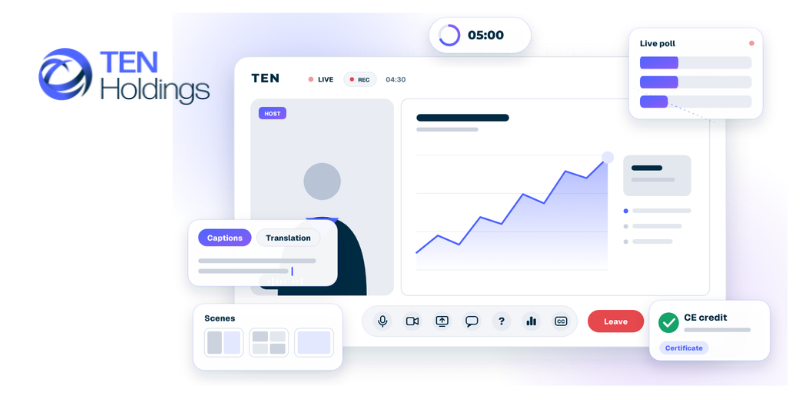
TEN Holdings, Inc. is a technology company built around TEN, a Digital Experience Platform for creating, producing, engaging, marketing and measuring digital experiences, beginning with enterprise events, webinars and continuing education. TEN scales up to 50,000 concurrent attendees and is backed by more than a decade of experience producing mission-critical corporate broadcasts for Fortune 500 clients. The Company plans to expand TEN beyond events and webinars, including AI and automation, landing pages, integrations, engagement, reporting and analytics, and content studio.
Virtual meetings, webinars, and hybrid conferences have become established parts of business operations, creating new opportunities to reach audiences across geographic boundaries. Yet the proliferation of digital experiences has also complicated the task of understanding what meaningful engagement looks like.
Meanwhile, artificial intelligence has become a fixture of corporate strategy, promising to change how businesses operate, communicate, and make decisions. Companies are committing substantial resources to the technology, even as executives work to understand its financial implications.
McKinsey’s 2025 State of AI report quantifies it: 88 percent of surveyed organizations use AI in at least one business function, but only 39 percent reported an impact on enterprise-level operating earnings. Adoption is not the same as results.
As investment continues, the ability to demonstrate meaningful returns will increasingly determine which AI applications become essential to corporate operations.
That challenge is especially apparent in corporate events and enterprise communications, where digital platforms have expanded how organizations connect with employees, customers and investors. Attendance figures and registration totals provide useful information, but they reveal relatively little about whether participants absorbed information, developed stronger relationships, or took meaningful action afterward. Organizations need to know if their communications change behavior and support broader business goals.
The growing importance of engagement analytics reflects this shift in corporate priorities. A webinar attracting thousands of participants may look like a win, although its lasting value depends on what those participants learn and do afterward. Start by examining audience participation, content preferences, the questions submitted during presentations, and what they do next.
The data becomes particularly useful when it ties to a specific objective, such as improving employee training, generating qualified sales opportunities, or stronger investor understanding. Over time, a more disciplined approach to engagement data can help organizations make better decisions about how they allocate resources and communicate with important audiences.
AI can make that data considerably more useful by finding patterns across large volumes of audience activity. Machine learning tools can help organizations recognize which subjects attract sustained interest, where participants disengage, and how different groups respond to particular content. AI-assisted transcription, summarization, and personalized follow-up can also make digital experiences more accessible while reducing administrative demands.
At TEN Holdings, we built TEN, a Digital Experience Platform, around a simple idea: events are where engagement starts, not where it ends.
TEN is designed to bring creating, producing, engaging, marketing, and measuring digital experiences into one connected process so that what we learn from each event improves the next one. The opportunity is to help businesses understand their audiences and communicate more effectively.
The financial implications extend well beyond the technology itself. Having worked in investment banking and corporate finance before moving into executive leadership, I have seen how easily enthusiasm for emerging opportunities can outpace the discipline required to evaluate them.
AI deserves the same scrutiny as any major expense: realistic projections, defined performance benchmarks, and a clear view of ongoing costs. Ask whether a proposed application will improve productivity, cut operating costs, strengthen customer relationships, or drive revenue growth. These assessments should also account for implementation, employee training, cybersecurity, and the organizational changes necessary to make new systems effective.
In corporate events, some benefits show up quickly. Automating registration workflows, event summaries and post-event communications can reduce the time employees spend on repetitive tasks. Other outcomes, including improved customer loyalty, stronger employee engagement and more effective investor communications, may require longer periods of observation.
A useful measurement framework should therefore combine immediate operational indicators with longer-term assessments of business performance. Set the benchmarks before you deploy. Otherwise, you have nothing to measure the investment against.
Execution decides whether the returns are realized.
A separate McKinsey analysis of AI adoption and business value found that redesigning workflows was among the factors most closely associated with financial benefits from generative AI. The finding has important implications for companies integrating AI into their corporate events infrastructure. Successful implementation requires technology teams, business leaders, and the people who deliver digital experiences working together. It also means rethinking established processes so new capabilities serve a defined business need.
Greater reliance on engagement analytics also brings questions about data quality, privacy and interpretation. Audience is a valuable signal, but it requires context to become useful business intelligence. A participant leaving a virtual presentation early, for example, may reflect scheduling constraints rather than dissatisfaction with the content.
Companies safeguard how they collect and analyze information while ensuring a human-in-the-loop review of automated recommendations. Trust is the foundation. Employees, customers and investors need to believe these sophisticated analytical tools are used responsibly.
The next phase of enterprise AI will belong to companies that connect the technology with measurable business outcomes.
Corporate events offer a particularly revealing example because their effectiveness depends on communication, participation, and the quality of relationships developed over time. As digital platforms become more sophisticated, executives will have greater opportunities to understand how those interactions contribute to overall performance. The companies that benefit most will invest with financial discipline, clear objectives and a commitment to responsible implementation.
Ultimately, the enduring value of enterprise technology will depend on its ability to help organizations communicate more effectively, make better decisions, and achieve results that justify the investment.
Related News:
ControlUp Launches Pulse AI Resolve for AI-Powered IT Troubleshooting and Endpoint Remediation
Bitdefender and NETGEAR Release the 2026 IoT Security Landscape Report