
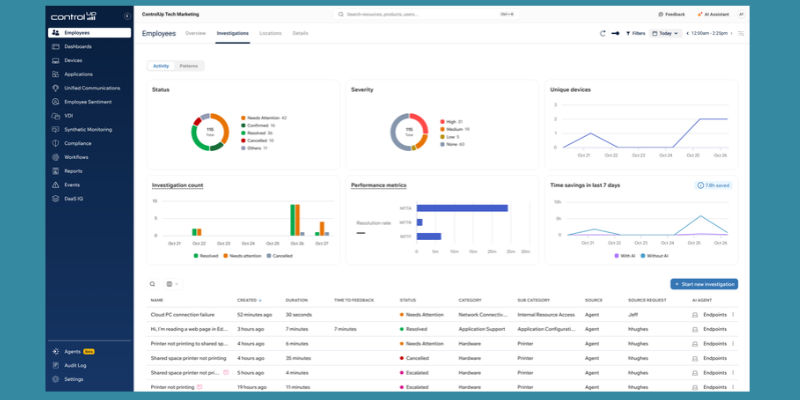
ControlUp announced the launch of Pulse AI Resolve, a real-time AI-powered investigation and remediation solution within its Pulse AI ecosystem. Building on the company’s endpoint self-service capability, formerly known as ControlUp Connect, Pulse AI Resolve introduces automated IT troubleshooting, proactive issue detection, and built-in governance controls directly at the endpoint. The solution is designed to accelerate IT issue resolution, improve employee productivity, and reduce support ticket volumes by minimizing the need for manual IT intervention.
For decades, enterprise IT support has followed essentially the same escalation model. An employee encounters a problem, IT investigates it, known issues move through first-line support, and more complex problems escalate to specialists.
Pulse Resolve adopts the mental model of that familiar tiered helpdesk ladder, applying graduated escalation based on the complexity of the issue and bringing automation and optimization to every support tier. This shifts more troubleshooting and remediation closer to the endpoint, allowing more issues to be resolved before they require help desk intervention.
“IT teams shouldn’t have to spend their days chasing tickets that AI can investigate and resolve,” said Gadi Feldman, Chief Product Officer at ControlUp. “Pulse AI Resolve puts intelligence and action where the problem is. By combining AI-powered IT self-service with proactive detection and remediation and governance, we can resolve more issues before they reach the help desk, while IT remains in control. That combination fundamentally changes how IT support is delivered.”
Pulse Resolve runs on the employee device and monitors endpoint performance to identify problems early. When an issue occurs, Pulse Resolve can investigate live device data, determine a likely cause and apply an appropriate remediation based on the level of autonomy established by IT.
Whether it detects the problem first or an employee initiates support by describing an issue in plain language, the same AI-powered IT self-service experience can investigate, diagnose and move the issue toward resolution.
IT admins can also trigger Pulse Resolve directly when a ticket arrives with little or no context. In this “cold ticket” scenario, Pulse Resolve triages, diagnoses, and remediates on the admin’s behalf, before end user outreach is required.
Pulse AI Resolve operates across four tiers of the support ladder, escalating step by step only as an issue’s complexity requires.
The first three tiers are designed to resolve issues autonomously within IT-defined policies and controls:
- Pattern Matching: Recognizes recurring issues and applies IT-approved fixes automatically, mirroring first-line support
- Actions Library: Assembles across 400+ custom actions to resolve issues that don’t match a known pattern, much like a second-line technician
- Agentic AI: Reasons through complex problems and applies fixes within IT-defined governance boundaries, like a specialist working the complicated cases
- Human Handoff: Escalates to IT with full diagnostic context already gathered and analyzed, so the next tier never starts from scratch
This structured workflow extends beyond individual endpoints. By leveraging MCP integrations, Pulse Resolve seamlessly coordinates multi-system remediations, that include handling tasks such as granting access, password resets, and application installs, all within the guardrails and policy constraints established by IT.
Keeping IT in Control
Governance is built into every level of Pulse AI Resolve. IT defines which issues can be resolved autonomously, where approval is required, and when to escalate. Organizations can configure automatic remediation for routine issues, require approval for system-level changes, restrict investigation to certain device groups, and escalate based on custom rules.
Pulse Resolve operates through role-based access controls, organizational policies, approval rules and user consent. Diagnostic analysis takes place locally on the endpoint using targeted, time-bounded data relevant to the issue while excluding personal or unnecessary information. If it reaches the limits established by IT, it stops and escalates rather than moving beyond those boundaries. The same controls apply whether an investigation is triggered by the endpoint, an employee, or an IT admin.
Pulse Resolve is available now. To learn more, read this blog or schedule a demo.
Related News:
ControlUp Finds Sign-In Issues Account for Up to 53% of IT Help Desk Tickets
Cato Networks Launches AI Endpoint for Enterprise AI Security and Data Protection