
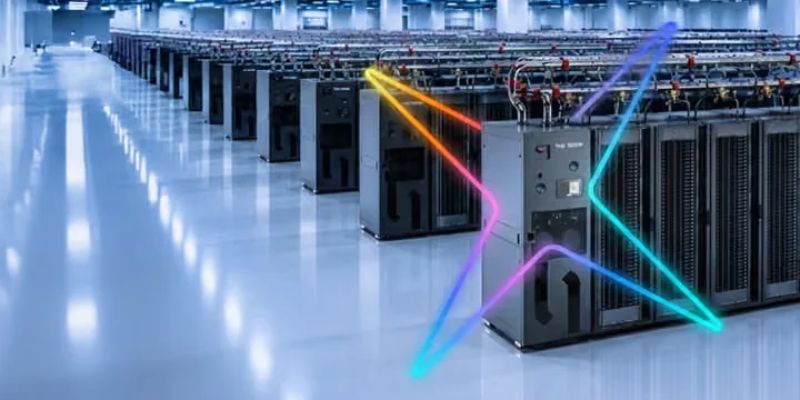
Ecolab announced the launch of an open AI infrastructure ecosystem at SC26, bringing together technology, manufacturing, and service partners to accelerate next-generation data center development. The collaborative initiative is designed to help data center operators streamline the transition from design to production while enhancing operational performance, reliability, and energy efficiency. The ecosystem also aims to reduce water consumption and support more sustainable AI infrastructure development.
The announcements are part of a broader plan to lead in the development of the industry’s most advanced AI infrastructure. Each partnership addresses separate stages of the data center lifecycle – Dassault Systèmes as a leading industrial AI virtual twin partner, Siemens for power distribution and intelligent infrastructure expertise and Alfa Laval’s for its highly efficient heat exchange and flow technology – and all connect into Ecolab’s first smart thermal management system for direct liquid cooling.
“AI is advancing at an extraordinary pace, and the infrastructure behind it needs to advance just as fast,” said Christophe Beck, Ecolab chairman, president and chief executive officer. “That’s why we’re bringing the best in the industry together to move faster from design to first token. Together, we’re building the next generation of AI infrastructure.”
Siemens: Optimized power and cooling solution
The next generation of AI infrastructure demands a fundamental shift in data center architecture: cooling and power can no longer be addressed in silos. Siemens and Ecolab are joining forces to deliver an integrated, deployable power and cooling solution engineered specifically for high-density AI workloads.
By combining Ecolab’s advanced liquid-cooling and CDU technology with Siemens’ power distribution, automation, software, and digital twin capabilities, the collaboration bridges the physical and digital layers of the data center. This unified approach is working to solve critical thermal challenges, cut deployment complexity, and dramatically accelerate time-to-token – delivering true IT/OT convergence at scale.
“The thermal and energy demands of AI workloads have made piecemeal data center architectures obsolete,” said Peter Koerte, President of Siemens Smart Infrastructure and Member of the Managing Board. “Together with Ecolab, we are tackling the industry’s biggest bottleneck: building high-performance AI infrastructure fast, efficiently, and sustainably.
By integrating advanced liquid cooling directly with Siemens’ power, automation, and digital-twin technology, we will give operators a proven, scalable blueprint that minimizes water and energy consumption while accelerating time-to-token.”
Alfa-Laval: Next-generation heat exchangers
Ecolab’s next-generation CoolIT CHx™ 3000 CDUs initiative includes a collaboration with Alfa Laval, selected for its heat exchanger and flow components expertise. The partnership brings together Alfa Laval’s know-how in high-efficiency heat exchangers, pumps, and valves; and Ecolab’s experience in thermal loop management – ranging from facility-level cooling water treatment to direct-to-chip liquid cooling.
“As a leader in heat exchangers and flow components, Alfa Laval is committed to meeting the most demanding customer requirements for data center heat-transfer performance, reliability, and scale,” said Tom Erixon, President and CEO of Alfa Laval. “Our collaboration with Ecolab drives solutions for sustainability, energy efficiency and heat re-use to ensure performance and uptime throughout the lifecycle of data center.”
Dassault Systèmes: Industry’s first comprehensive cooling loop
Ecolab’s virtual twin showcase at Supercomputing 2026, developed in collaboration with Dassault Systèmes, links Technology Cooling System (TCS) and facility water system (FWS) models to simulate AI data center performance, from rack design inputs through the coolant distribution unit (CDU) and coolant selection to optimize compute.
This virtual twin reveals cooling infrastructure trade-offs between water use, coolant performance, power efficiency, and CDU redundancy, measured as water per token, token efficiency, and time to token capacity. The physics- and chemistry-based model is designed to help identify the optimal CDU architecture, the right coolant selection, and safest facility water temperature to optimize data center performance.
“Data centers are pushing infrastructure design to a new level of complexity, and the right decisions need to be made earlier, with the full picture,” said Elisa Prisner, Executive Vice President, Strategy, Industry, Marketing & Transformation, Dassault Systèmes. “Virtual twins let the industry connect chemistry, thermal engineering and water management in a single model, so that these AI factories can be designed to be more efficient from the start. Dassault Systèmes working with Ecolab shows what this approach makes possible.”
Learn more at https://www.ecolab.com/en-us
Related News:
AgentSense Protects Enterprises from Harmful AI Agent Behavior