
Iru released its State of Compliance Automation Report, highlighting the business risks associated with manual compliance processes. Based on a survey of 860 U.S. IT, security, and compliance professionals, the research found that reliance on manual evidence collection leaves organizations vulnerable to regulatory fines, failed audits, and lost business opportunities. The findings reveal that even organizations making substantial compliance investments remain exposed to these risks, underscoring the importance of compliance automation.
The report finds that despite around half (48%) of respondents describing themselves as continuously audit-ready, two-thirds (67%) still collect a meaningful share of compliance evidence by hand. Just 6% have fully automated evidence collection; an approach that can help to end the pre-audit scramble, which often erodes productivity, adds extra cost, and increases compliance exposure.
This is having a major business impact on organizations.
“Nearly half of teams told us they’re continuously audit-ready, but only 6% have actually automated how they collect evidence. That gap between confidence and reality is the story of this report,” said Ali Khan, CISO at Iru. “Compliance programs have grown faster than the systems behind them. The teams managing the most frameworks are the most likely to still be collecting evidence by hand, and they’re the ones paying for it in fines, follow-up requests, and hours.”
Manual Collection Costs Businesses Money
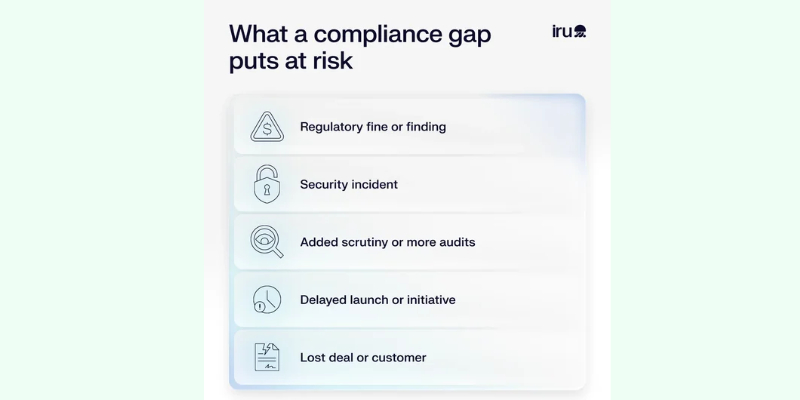
Teams collecting evidence manually report a regulatory fine or formal finding — such as a control failure, non-compliance, or missing evidence — at twice the rate of mostly or fully automated teams (22% vs. 10%).
Eighty-one percent of manual teams report at least one negative consequence tied to a compliance gap or failed audit readiness. The figure is just 69% for automated teams.
Alongside a stronger likelihood of fines or formal findings, manual teams are also more likely than automated teams to report a lost deal/customer (17% vs 10%), increased scrutiny/audits (31% vs 21%), or security incidents due to non-compliance (28% vs 19%), the report reveals.
Automation matters more as the compliance workload grows. For teams managing 1-5 frameworks, there is virtually no gap in the number of negative consequences reported by respondents. But for those handling 16-20 frameworks, manual teams are 18 percentage points more likely to report negative consequences (97% vs 79%).
Why Automation Stalls
The report reveals that the tasks most likely to be automated are the ones IT fully owns, like cloud-based compliance, device posture checks, and vulnerability scanning (all sitting at or above 50% of respondents).
Those less likely — including security training, third-party risk assessments, and access reviews — all depend on people or systems outside IT. This suggests that automation tends to stall when compliance work crosses from one team’s system to another’s.
Organizations cite a shortage of IT or engineering resources (47%) as their biggest barrier to automating compliance, considerably more than those who point to budget pressures (34%).
Yet even those who spend more on compliance don’t necessarily adopt more automation. The report finds that 43% of the highest-spending group ($250K) still collect evidence by hand, versus 40% of those spending under $50,000.
“The data says this isn’t a budget problem. The highest spenders are just as manual as the lowest, and the number one barrier teams named was not having the engineers to build automation,” said Khan. “Where automation has worked is where the evidence already lives in a system IT owns or can reach through an API. Where it stalls is whenever the system doesn’t support APIs or ownership is outside of IT.”
Read the full report here: https://www.iru.com/blog/compliance-automation-report
Related News:
OneTrust Fall ’26 Release Advances AI Governance, Privacy Automation, and Risk Management
Ecolab Launches Open AI Infrastructure Ecosystem to Accelerate Data Center Development