

Digital Employee Experience DEX platforms and tools have become mission-critical as organizations support hybrid workforces, reduce IT noise and proactively resolve issues before they impact productivity. With hybrid and remote work now a permanent fixture, Gallup reports 52% of remote-capable employees work in hybrid models and 26% work exclusively remote. IT teams are under pressure to ensure seamless digital experiences. At the same time, industry analysts estimate the DEX market is growing at a double-digit CAGR as enterprises prioritize proactive monitoring, automation and employee sentiment tracking.
Although the vendors below all operate in the DEX space, they approach the challenge from different angles. Some emphasize behavioral analytics and experience scoring, others focus on real-time remediation or remote support and some integrate DEX into broader workspace management ecosystems. Understanding these differences is essential when aligning a platform to your organization’s size, IT maturity and operational priorities.
Nexthink
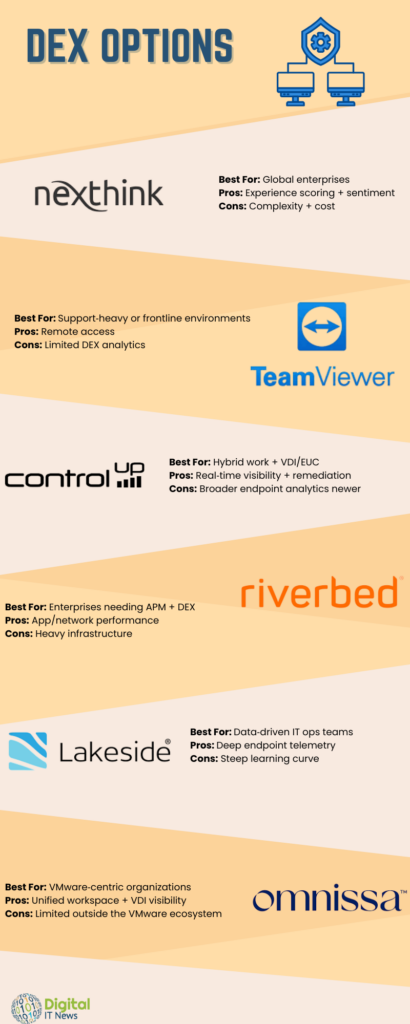
Nexthink is best suited for large enterprises that require deep behavioral analytics, employee sentiment tracking and proactive experience scoring across global environments. This platform is known for its robust experience-score framework, which combines endpoint telemetry with employee feedback to provide a holistic view of digital experience. Organizations operating across multiple geographies often benefit from Nexthink’s ability to surface trends, detect systemic issues and automate remediation workflows before they escalate into widespread productivity disruptions.
However, Nexthink’s depth also has complexity. Deployment and operationalization can require significant planning and dedicated internal expertise. The platform also requires a greater financial and resource investment than other lighter-weight solutions, so its greatest value is typically realized in large, distributed enterprise environments where advanced analytics justify the cost and operational effort.
TeamViewer: Tensor + Remote Management
TeamViewer’s Tensor and Remote Management solutions are particularly well-suited for organizations that prioritize remote access, remote control and device support across distributed or frontline workforces. The company has long been recognized as a leader in secure remote connectivity and its DEX capabilities build upon that strength by enabling IT teams to diagnose and resolve issues quickly across diverse device types and operating systems.
The platform excels in lightweight deployment and broad device compatibility, making it attractive for organizations with field employees, retail environments or non-traditional endpoints. However, TeamViewer is not positioned as a full-spectrum DEX analytics platform. While it provides visibility into device health and performance, it does not offer the same depth of behavioral analytics or sentiment tracking found in analytics-first DEX vendors. As a result, it is often best positioned as a powerful remote support solution rather than a comprehensive digital experience management platform.
ControlUp ONE
ControlUp ONE is a strong fit for enterprises managing hybrid workforces, virtual desktop infrastructure (VDI), Desktop as a Service (DaaS) or complex End-User Computing (EUC) environments. The platform is recognized for delivering real-time performance metrics across endpoints, virtual environments and SaaS applications, allowing IT teams to identify and quickly remediate issues. Its real-time troubleshooting capabilities and automated remediation workflows are particularly valuable for organizations handling high volumes of support tickets.
ControlUp has historically been strongest in EUC and VDI environments, like Citrix, VMware and Microsoft ecosystems. While the company has expanded into broader endpoint analytics, organizations may need thoughtful integration planning to maximize cross-platform visibility. However, for IT teams operating complex digital workspaces, ControlUp’s emphasis on speed, automation and actionable insights can translate into measurable reductions in downtime and support workload.
Riverbed: Aternity
Riverbed’s Aternity platform is designed for large enterprises seeking deep application performance monitoring combined with end-user experience insights. The solution integrates network visibility, application performance analytics and endpoint telemetry, making it particularly appealing to organizations with close-knit IT operations and network teams.
Aternity’s mature, enterprise-grade analytics provide detailed insight into how application performance impacts employee productivity. This infrastructure-aware approach can be invaluable in complex environments where network latency, cloud performance or application bottlenecks significantly affect user experience. However, for organizations that do not require integrated APM or network-centric analysis, the platform may feel more infrastructure-heavy than necessary compared to lighter DEX-focused tools.
Lakeside Software: SysTrack
Lakeside Software’s SysTrack platform is well known for offering some of the most granular endpoint telemetry in the DEX market. IT teams focused on capacity planning, hardware lifecycle management and root-cause analysis often value the depth of data collection available through SysTrack. The platform’s comprehensive diagnostic capabilities make it especially useful for identifying persistent or difficult-to-reproduce performance issues.
However, this level of data richness can be overwhelming without experienced analysts who can interpret and operationalize the insights. Compared to newer DEX platforms that emphasize simplified dashboards and employee sentiment scoring, SysTrack’s interface and workflows feel more technical. Organizations that prioritize detailed engineering-level diagnostics over experience scoring may find this tradeoff worthwhile.
Omnissa: Formerly VMware EUC
Omnissa is best suited for organizations already invested in VMware Workspace ONE or Horizon. Its DEX capabilities are tightly integrated into the broader VMware ecosystem, enabling unified device management, workspace orchestration and visibility into Horizon VDI performance.
This tight integration offers significant advantages for VMware-centric environments, as IT teams can manage endpoints, applications and digital experiences within a single ecosystem. However, organizations outside the VMware stack may not realize the same level of value. Additionally, while Omnissa’s DEX capabilities continue to evolve, analytics-first vendors may still offer deeper standalone experience scoring and behavioral analytics. Platform complexity can also pose challenges for smaller IT teams that lack dedicated EUC expertise.
Final DEX Considerations: Align With Your Priorities
Selecting the right DEX platform depends on organizational priorities. Enterprises focused on advanced analytics and sentiment measurement may gravitate toward analytics-driven vendors. Organizations managing complex VDI or hybrid infrastructures may prioritize real-time remediation and EUC visibility. Those with large frontline or distributed workforces may focus on remote support capabilities.
As hybrid work remains the norm and employee expectations for seamless digital experiences rise, DEX platforms are no longer optional tools but strategic investments. Matching platform strengths to operational goals reduces IT noise, improves productivity and delivers measurable improvements in employee satisfaction.
More Endpoint NewsRelated News:
SACR Highlights Britive’s Role in Third-Gen PAM
Unipath Acquisition Strengthens ControlUp’s AI Leadership
Keeper Security Launches Slack Integration for Zero Trust