
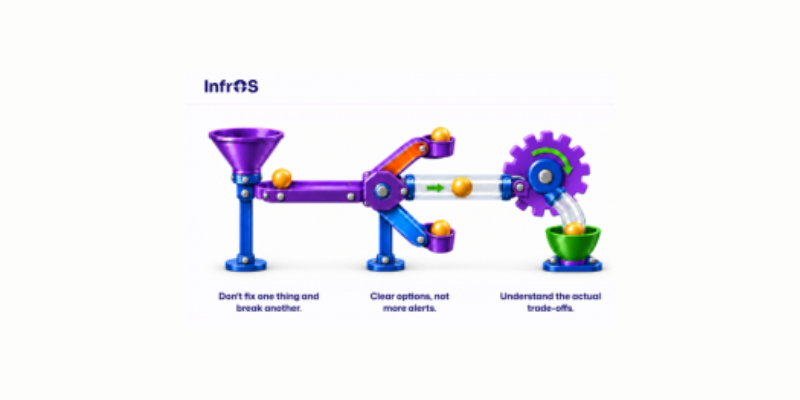
InfrOS has introduced Evolving Architecture, a new capability that helps organizations keep cloud workloads aligned with changing requirements before infrastructure choices become outdated or difficult to change. The technology addresses a growing challenge in complex cloud environments, where infrastructure that was suitable at deployment can become inefficient, costly or inadequate as application demands, traffic patterns, security requirements and cloud-provider capabilities evolve.
Evolving Architecture can be installed on existing workloads or included with newly deployed environments. It continuously detects infrastructure drift and can recommend changes when a workload no longer complies with its requirements, or when a new cloud-provider capability creates an opportunity to improve performance, resilience, security or cost. Every recommended fix or upgrade is emulated before deployment. InfrOS then presents the expected effort, risk and benefits across seven dimensions: performance, security, cost, reliability, scalability, maintainability and deployment complexity.
“Companies are making $100 billion plus bets on energy and infrastructure, especially as they build for AI,” stated Naor Porat, co-founder and CEO of InfrOS. “However cloud and AI infrastructure are not one-time investments as workloads, business requirements and technologies all change rapidly and continuously in the age of AI. We created Evolving Architecture to measure and then close the gap between what was invested in and what is actually needed today, in real time. InfrOS’ capability simulates and tests changes to the infrastructure prior to the actual investment of capital and the engineering efforts required to implement changes in production to ensure a successful implementation.”
“InfrOS already makes you better. Now their Evolving Architecture turns your live infrastructure from a black box into a decision engine. Automated mapping shows everything that’s running, knowledge enrichment explains why it’s there, the Cost Optimization Analyzer flags the waste with evidence, and Gain/Risk/Effort scoring tells me what’s worth doing first. No manual audits, no guesswork, just answers,” said George Bock, Chief Information Officer at Redion US.
According to Gartner, the current period of rapid growth in technology infrastructure is entering a new phase of investment in AI-optimized IaaS (infrastructure as a service) and forecasts spending on such services will grow by 96% in 2026 to reach $42 billion. This level of investment in infrastructure spending magnifies the potential risk of poor and static, unchangeable infrastructure decision making as conditions evolve.
“Working with the InfrOS team was a very positive experience. The platform not only identified meaningful cloud optimization opportunities but also provided the context and prioritization needed to turn insights into actionable next steps,” said Michalis Michailidis, Technology, Innovation, and Digital Services for PPC, the leading electric utility company in Greece.
InfrOS’ new Evolving Architecture capability supports workloads deployed across AWS, Google Cloud, Microsoft’s Azure, and OCI as well as other multi-cloud and hybrid environments. To learn more about Evolving Architecture, visit InfrOS Product: Adaptive Cloud Infrastructure Design Engine here.
Plan to attend KubeCon + CloudNativeCon North America? Stop by booth #360 for a demo and to learn more.
Related News:
IT Professionals Day: Where are We Headed?
IP Fabric Expands Platform for Application-Aware Infrastructure and AIOps