
Ontada is an oncology technology and insights business dedicated to transforming the fight against cancer. Part of McKesson Corporation, Ontada was founded on the core belief that precise insights — delivered exactly at the point of need — can save more patients’ lives. The company connects the full patient journey by combining technologies used by The US Oncology Network and other community oncology providers with real-world data and research relied on by all top 15 global life sciences companies. Their work helps accelerate innovation and powers the future of cancer care.
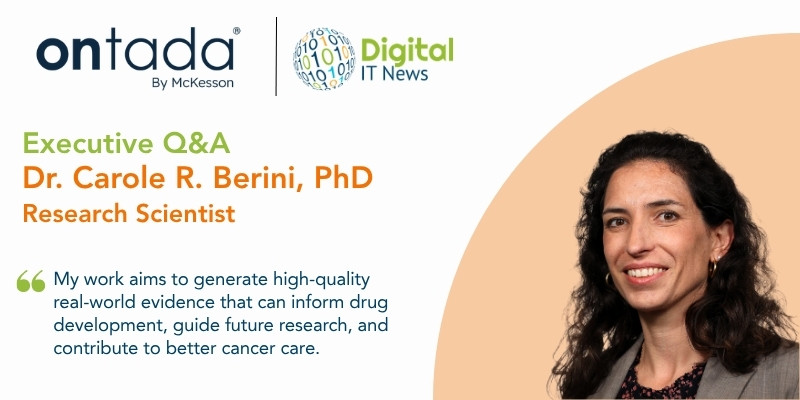
Carole Berini, PhD, Research Scientist in at Ontada, is a health services researcher specializing in oncology real-world evidence (RWE) and health economics and outcomes research (HEOR). She leads the design and execution of HEOR and RWE studies as an expert in translating complex clinical data into actionable insights that shape clinical, commercial, and policy decisions.
What experience most shaped your approach to real-world evidence research?
The experience that has most shaped my approach is the combination of strong mentorship and continuous learning from the broader scientific community. My mentors reinforced the importance of methodological rigor, clinical relevance, and transparency about the data, such as where they come from, how they are collected, and whether they are fit to answer the specific research question.
Conferences such as ISPE have also been invaluable because they bring together researchers, epidemiologists, regulators, industry professionals, and data scientists to discuss emerging methods and practical challenges in real-world evidence.
That type of exchange directly informs how I approach studies such as our ECOG performance status proxy work. The goal was not simply to apply advanced methods, but to evaluate whether those methods could help address an important and practical limitation in oncology electronic health record data in a way that is scientifically and clinically meaningful.
What led you to become a research scientist in oncology, real-world evidence?
Like many people, I have lost loved ones to cancer, so oncology research has always felt personally meaningful. Real-world evidence is a way to address questions that matter to clinicians and patients by studying care as it is delivered in everyday practice. I was also drawn to the complexity of the field. Each study is unique and requires close attention to clinical context, careful epidemiologic design, and a realistic understanding of how data are generated during routine care. That combination of scientific challenge and potential impact is what led me to focus my career on real-world evidence in oncology.
What makes real-world oncology data valuable for your research?
Real-world oncology data are valuable because they reflect what happens in routine clinical practice, beyond the more selected populations and controlled conditions of clinical trials. They can help us understand treatment patterns, patient characteristics, outcomes, and gaps in care across broader oncology populations, especially in community settings. Nonetheless, these data require a thoughtful approach. Our team invests considerable effort in transforming information collected at the point of care into high-quality, research-ready data by applying clinical expertise, data curation, quality checks, and robust study design.
Our ECOG proxy project is a good example. ECOG performance status is an important measure of a patient’s functional status that can influence treatment selection and outcome, yet it is not always consistently documented in electronic health record data. We evaluated whether routinely available structured data could support scalable proxy measures for patients with advanced prostate cancer. A reliable proxy could help researchers retain and characterize patients who might otherwise be excluded because ECOG performance status was not recorded at the time point needed for a study.
What current study or method are you most excited about?
I am especially interested in methods that make real-world evidence more reliable, interpretable, and clinically useful. Target trial emulation is one example because it encourages researchers to design observational studies with the same level of clarity and discipline used in randomized trials, which is particularly important as real-world evidence is increasingly considered in regulatory and clinical decision-making.
At the same time, even a strong study design can be limited by incomplete clinical information. ECOG performance status illustrates this challenge: it is clinically important and commonly used in trial eligibility criteria, but it may be missing. Restricting analyses to patients with complete documentation can reduce sample size and introduce selection bias. In our study, we explored machine learning and multiple imputation approaches to assess the feasibility of building a proxy for ECOG performance status.
What helps make real-world evidence clinically meaningful?
Real-world evidence becomes clinically meaningful when the research question, data source, study design, and interpretation are aligned to produce reliable and actionable results. Collaboration with clinicians is essential because they understand the patient journey, documentation practices, and the clinical nuances behind the data. Researchers then translate those insights into study design, applying epidemiologic principles to minimize bias and address challenges such as confounding, missingness, and measurement limitations. The result is evidence that reflects real-world clinical practice and can help inform decision-making across oncology care.
In our ECOG study, we observed clinically coherent predictors across analytic approaches, which increased our confidence that the signal was meaningful. For example, poor ECOG performance status was associated with older age, low body mass index, and low hemoglobin, findings that are consistent with functional vulnerability. This work remains at the feasibility stage and requires further refinement and validation, particularly by assessing how the proxy performs in downstream analyses.
What is one challenge of working with real-world data, and how do you address it?
Electronic health record data are exceptionally rich, but they are created to support patient care, not research. Important information may be spread across structured and unstructured fields, such as laboratory results, imaging documentation, and physician notes. This can make the data complex, variable, and incomplete.
We address this challenge with a multidisciplinary, fit-for-purpose approach. That means understanding how the data are generated, where limitations may exist, and whether the data are appropriate for the research question. We rely on the expertise of researchers, clinicians, biostatisticians, and clinical data quality specialists working together to ensure that studies are not only methodologically strong but also grounded in oncology practice.
In addition, validation work is also essential to demonstrate that the data, the approach, and the findings are reliable. This is an important next step for our ECOG performance status proxy work.
How does your role contribute to oncology evidence generation?
As a research scientist, my role is to develop and lead studies that generate clinically relevant evidence in oncology. This includes translating clinical and scientific questions into feasible study designs, assessing whether the data are fit for purpose, collaborating with statisticians on analytic approaches, and interpreting findings in ways that are meaningful to clinicians, life sciences partners, and other stakeholders.
More broadly, my work aims to generate high-quality real-world evidence that can inform drug development, guide future research, and contribute to better cancer care.
Related News:
Administrative Bottlenecks Drive Patient Delays in U.S. Healthcare
Solera Health Study Shows Cost Savings and Improved Outcomes