
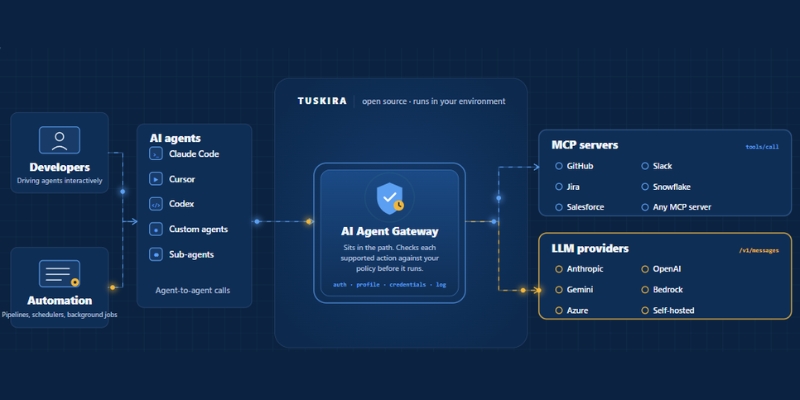
Tuskira introduced the Tuskira AI Agent Gateway, an open-source, self-hosted solution built for developers, platform teams and security professionals. The centralized gateway allows teams to configure models and tools, view supported calls, enforce policies, manage access, monitor token usage and change models without requiring changes to existing AI agents.
The gateway runs entirely inside an organization’s environment. It requires no Tuskira account or hosted service, and the organization retains control of its configuration, policies and logs.
Teams are adopting AI agents faster than they can manage them. Coding assistants such as Claude Code, Cursor, and Codex; AI productivity assistants such as Claude Desktop; and custom agents built in-house each connect to models and tools using their own settings. As a result, organizations often lack a consistent view of what their agents do, what they access and what they cost.
Model routing, MCP access control, activity logging and token management are increasingly sold as separate commercial services. Tuskira is bringing them together in one open-source gateway that organizations can operate inside their own boundaries.
“AI agents are moving into production faster than organizations can manage them,” said Piyush Sharma, CEO and Co-founder of Tuskira. “Teams are wiring agents to models and tools independently, without a shared view of what those agents do or what they cost. Visibility and control over agent activity should be basic infrastructure, so we’re making it open source for any organization to run.”
One Gateway Between Agents, LLMs and MCP Tools
The Tuskira AI Agent Gateway sits in the path between supported AI agents and the LLMs, MCP servers, and tools they use.
Supported environments include:
- Coding assistants such as Claude Code, Cursor and Codex
- AI productivity assistants such as Claude Desktop
- Custom agents, including sub-agents and agent-to-agent workflows
- Automated agents running through pipelines, schedulers and background jobs
Teams configure models, tools and access through the gateway instead of managing them separately within each agent. Because the gateway evaluates supported actions before execution, teams can apply policy to both individual actions and which agents can access specific tools.
With the gateway, teams can:
- Route LLM calls through one endpoint: Send calls to Anthropic, OpenAI, Gemini and AWS Bedrock through one surface with your own keys, with token usage and cost captured per call.
- Control MCP tool access: Use centralized profiles to manage which MCP servers and tools each agent may use.
- Enforce access on every call: Each tool call is checked against the agent’s profile at execution time. Ungranted calls are denied and every call is logged.
- See agent activity: Record supported model and tool calls, the systems agents contact and the actions they attempt.
- Track token spend: Measure token usage across agents and models to understand adoption and operating cost.
- Keep records local: Store actions, policy decisions and outcomes inside the organization’s environment and export those records to existing logging and analysis tools.
Open Source and Self-Hosted
Tuskira is releasing the AI Agent Gateway as an open-source community project. Organizations can deploy it inside their own boundaries, inspect how it works, extend it and contribute to its development.
The release includes:
- Installation and deployment guides
- Documentation for supported agents, LLM providers and MCP servers
- Example configurations and access profiles
- Policy, logging and token-tracking guides
- Contribution and community guidelines
Learn more about Tuskira AI Agent Gateway at the website here.