
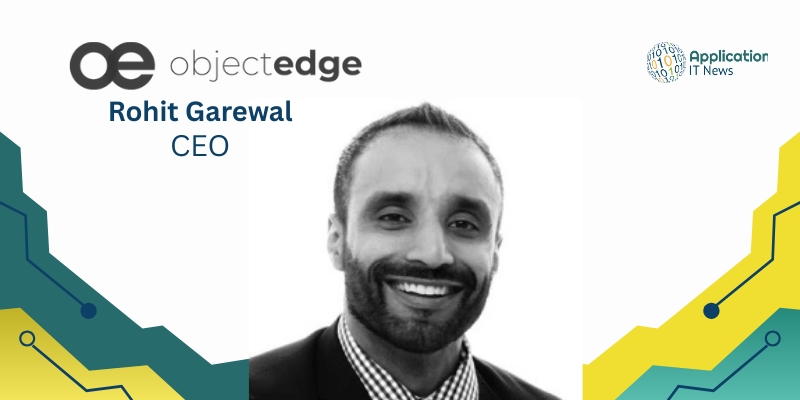
Object Edge is a digital consultancy built on the belief that real transformation happens when complex challenges are met with clarity and disciplined execution. For over 30 years, it has helped global enterprises modernize commerce, data, and revenue operations with solutions at the intersection of Salesforce, Palantir, and AI. From predictive quoting to CPQ control layers, Object Edge tackles the technical and operational problems others avoid—delivering measurable business transformation.
Rohit Garewal, CEO of Object Edge, is a transformation-driven leader whose career blends deep technical experience with a passion for people-powered growth. With more than 15 years in global eCommerce, he has helped brands across the Americas and beyond reinvent their digital ecosystems, modernize high-touch sales processes, and adapt to the data revolution shaping enterprise commerce. His leadership centers on merging foundational business disciplines with next-generation technology to deliver profitable, scalable transformation for B2B organizations.
1. Career Journey: Can you share the most interesting story that happened to you since you started your career, especially one that shaped your leadership approach at your current company?
By far the most “interesting” part of my career was becoming a CEO for the first time and having ex-colleagues reporting to me. There was a period of “imposter” syndrome; though I felt I was the most qualified person for the job, there were definitely people in my organization better at specific responsibilities.
Almost everyone in a leadership position will have moments of doubt—but doubt from feeling that people didn’t believe in me was particularly daunting.
Two things changed for me over time.
First, I learned the humility that having people better than me in specific areas was good for the company. It made us more scalable and dynamic.
Second, was the reminder of the value of education. I immersed myself in books and peer groups with other CEOs to learn from and bounce ideas with. This gave me incredible confidence in presenting my ideas to my team.
2. Career Path: What initially brought you to this specific career path, and how did it lead to your role in this company?
I started in hardcore telco by learning about billing systems, and my first project out of college was merging the billing systems of (now-defunct) worldcom and ATT for the state of California.
While coding was what I grew up doing, a pivotal change in my career came when I started a company called Velociti Partners with some college friends, where I evaluated the software of Silicon Valley SaaS companies and compared them to competitors and explained to sales teams how to pitch the strengths of their product. This helped me blend my love for technology and my love for business. Today, I help enterprise leaders modernize how they optimize on Revenue and Margin, the two core pillars of for-profit companies, blending the skills of computer architecture with business engineering.
3. Company Differentiation: What makes your company stand out from competitors in the market? Can you share an example that highlights this?
Object Edge solves problems that most partners avoid. Our work sits at the intersection of Salesforce, Palantir, and AI workflows. We are known for helping manufacturers, telecom companies, and retailers bring order to chaos. Whether that means building predictive quoting systems, restructuring how SKUs connect to personas, or turning CPQ into a control layer, we do the work that actually changes business outcomes. The reason clients trust us is simple. We show up with clarity, we stay focused on the outcome, and we understand how enterprise systems really operate.
It’s trite and redundunt, but our difference from most is our people. If you throw enough smart, determined people at a problem, you can solve almost anything.
4. Product Innovation: Are you working on any exciting new products or projects? How do you think this innovation will positively impact your customers?
We are actively delivering generative AI workflows for manufacturing and telecom customers. These include quoting accelerators, lead generation automations, and self-service experiences, all powered by structured data and semantic models. By combining Salesforce Commerce Cloud, CPQ, and Palantir decision frameworks, we are helping clients drive automation, improve data governance, and increase quoting velocity.
5. Success Insight: What was the tipping point for your company’s recent success? Was there a change in strategy or approach that others might learn from?
The turning point was when we stopped offering transformation as a concept and started delivering “micro wins” with outsized gains. Clients are not asking for pilots anymore – at least not those that don’t have value. They want working systems that are integrated into their revenue and supply chain stack. We narrowed our focus to where we create the most impact. We realigned our messaging, deepened our vertical specialization, and built a repeatable demand engine that aligns with how decision-makers search and buy. That shift changed our pipeline and our partnerships.
6. Challenges and Lessons: Can you share a significant challenge your company faced and how you overcame it? What key lesson did that experience provide?
The hardest move we’ve made—and the most strategic—was cutting services that no longer aligned with where we’re going. It meant walking away from guaranteed revenue to protect our future relevance. That’s not a slide-deck decision. It’s a gut-check. We had to synchronize delivery, GTM, and leadership to say, “This is what we solve. This is who we solve it for.” The result? Less noise, more velocity. Specialization isn’t a constraint. It’s a growth flywheel.
7. Leadership Impact: In just a few words, what differentiates your leadership role from others in the company? What impact does this have on company culture or product success?
I’m the growth catalyst and culture architect. My job is to define the plays we run and the bets we take. I decide where we invest, what we say no to, and how we show up in the market.
I lead from the bottom of the org chart—supporting my team so they can support theirs. My responsibilities are simple: Growth, Culture, Fiscal Discipline, and Scalable Delivery. I want people better than me in each domain.
Leadership, to me, boils down to this:
- Have a vision – that’s on me
- Communicate it – me and my managers
- Inspire to it – me and my managers
- Execute it – my managers
In enterprise AI, clarity isn’t a luxury—it’s survival. My role is to bring consistency to our story, confidence to our clients, and urgency to our execution. That’s the difference between momentum and noise.
To learn more about how Object Edge delivers practical, scalable transformation, visit the website here.
Related News:
Q&A: Adaptiva’s Deepak Kumar on Autonomous Endpoint Management
Q&A: 10ZiG VP of Sales Stuart Pladgeman on Innovation and the Future of Thin Client Computing