
Atropos Health is closing medicine’s most consequential gap: actionable evidence to inform the vast majority of clinical decisions that are made without evidence. By generating real-world evidence from actual patient outcomes and data,
Atropos Health is building the evidence infrastructure that clinicians, life science researchers and AI platforms need to practice, develop and inform medicine, grounded in what actually works. Better healthcare is only possible with evidence, and Atropos Health is working to make it available for every patient, in every healthcare decision, every day. Atropos Health does this via GENEVA OS®, the operating system across a robust network of real-world data; Alexandria, the world’s largest evidence library; and evidence generation tools such as ChatRWD®, Green Button® and the Atropos Evidence™ Agent.
Can you share the most interesting story that happened to you since you started your career, especially one that shaped your leadership approach at your current company?
My career journey has largely been focused on health tech and data, but the experience that drove me toward it is very personal. I lost my mother to cancer when she was 44, and I was only 16 years old. That experience has largely shaped my career path and leadership approach at Atropos Health. It ignited my belief that medicine must produce high-quality, reliable real-world evidence directly at the point of care to help any patients and families facing similar challenges.
It reinforces why speed, data reliability and actionable insights are so critical across today’s entire healthcare ecosystem, where healthcare professionals, researchers, pharmaceutical companies and insurers constantly face hyper-specific patient questions that traditional publications and clinical trials simply can’t keep up with.
Career Path: What initially brought you to this specific career path, and how did it lead to your role in this company?
I am a pharmacologist by training. I earned my PhD in Clinical Pharmacology from Tufts University School of Medicine, where I also held research faculty positions. I spent years inside the traditional system that generates the evidence healthcare professionals typically turn to. Designing studies, running analyses, navigating regulatory scrutiny, conducting peer reviews and publishing.
However, that system was built for a world that produced clinical questions slowly and had the luxury of answering them over years, but that’s no longer our reality. It takes about five years for a clinical study to reach everyday practice.
Today, complex medical questions are arriving significantly faster than answers. Whether those questions come from clinicians treating patients with conditions never studied in combination or pharmaceutical companies looking to expand the label of an existing drug, the traditional system can’t keep pace.
This disconnect has created the Evidence Gap, where only 14% of daily medical decisions are backed by high-quality evidence. The remaining 86% of decisions usually rely on past training, clinical intuition, or even AI tools pulling from the same incomplete evidence base. I co-founded Atropos Health to successfully fill this gap by generating original, real-world evidence in real time from our network of 300 million real patient records from electronic health records, like Epic.
What makes your company stand out from competitors in the market? Can you share an example that highlights this?
As more healthcare organizations adopt AI and LLMs to fill the Evidence Gap, the primary challenge has shifted from data access to data reliability. When clinicians ask a traditional AI search tool about specific or underrepresented patient cases, those platforms often provide answers that are not grounded in trusted real-world evidence or include clinical hallucinations.
At Atropos Health, we built an AI evidence agent that connects to a federated network of 300 million de-identified patient records from electronic health record systems.
Through our platform, physicians can find patients just like theirs across hundreds of millions of patient records to see what treatments worked for that specific cohort. Our platform allows clinicians to generate new, real-world evidence on demand for the patient sitting right in front of them, rather than spending days searching through static, traditional literature.
Are you working on any exciting new products or projects? How do you think this innovation will positively impact your customers?
We are constantly advancing our AI evidence capabilities connected to our Alexandria library. This is the world’s largest body of medical evidence, containing over 500 million precision evidence-based findings and growing to 2 billion by the end of 2026. It allows clinicians, researchers, life science partners, payers and healthcare institutions to seamlessly access evidence to back a clinical decision based on a specific patient’s unique profile.
We recently announced a partnership with Microsoft, integrating the Atropos Evidence Agent directly into electronic health records and Microsoft Dragon Copilot for clinicians.
The Agent accesses the patient record and information like “reason for visit.” Based on this data, the Agent generates real-world evidence in real time to provide clinicians with documentation for treatment or other care decisions, without them ever needing to input a question.
What was the tipping point for your company’s recent success? Was there a change in strategy or approach that others might learn from?
The tipping point was recognizing that healthcare no longer needs more data; it needs actionable evidence generation rooted in reliable patient outcomes that healthcare stakeholders can trust and access in real time.
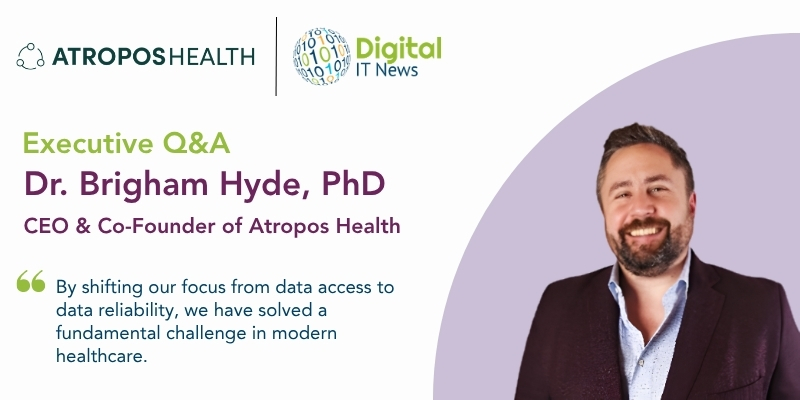
By shifting our focus from data access to data reliability, we have solved a fundamental challenge in modern healthcare AI. As I noted earlier, most traditional AI models often pull from an incomplete evidence base, generating clinical hallucinations or answers that are not grounded in real-world data.
A critical insight that others can learn from is that data availability alone does not solve today’s problems in medicine or tech. Making that data current, transparent, and embedded directly within a trusted workflow is what truly unlocks value for our customers and patients alike.
Can you share a significant challenge your company faced and how you overcame it? What key lesson did that experience provide?
An industry-wide challenge we faced was navigating the trust deficit in healthcare AI. Healthcare organizations quickly realized that rapid responses from traditional, consumer-facing AI platforms were often plausible-sounding guesses plagued by clinical hallucinations due to the lack of underlying data.
At Atropos Health, we have always remained laser-focused on what truly sets our platform apart. Every insight is backed by real patient records. We also take it a step further by embedding scientific rigor, source data audits and methodological transparency into the platform architecture, proving that speed does not have to come at the expense of clinical accuracy.
The key lesson is that technological capabilities without verifiable, transparent evidence will never earn the trust of healthcare stakeholders.
In just a few words, what differentiates your leadership role from others in the company? What impact does this have on company culture or product success?
My leadership role connects my background in pharmacology, health tech, and data with my personal purpose to close the Evidence Gap once and for all. This keeps our culture focused on scientific rigor, data reliability and delivering life-saving certainty directly to the point of care.
For more information, visit: https://www.atroposhealth.com/
Related News:
Health Universe Partners with Atropos Health for Clinical AI