

The endpoint computing market, once dominated by traditional PCs, has been steadily shifting toward PC alternatives such as purpose-built thin and zero client devices, driven by needs around security, manageability, cost savings, and adapting to hardware supply challenges that are reshaping the PC ecosystem.
Today, enterprises are weighing alternatives to traditional PCs for Virtual Desktop Infrastructure (VDI), Desktop-as-a-Service (DaaS), and cloud-delivered workspace deployments. But before diving into the product comparison, it is worth understanding a macro trend reshaping how endpoint hardware is procured and deployed: memory market pressures.
Industry Headwinds: Memory Shortages Reshaping Devices
The semiconductor memory market, particularly DRAM and NAND, went under intense strain in late 2025 and continues to struggle in 2026. A global imbalance between supply and demand has driven up prices and limited the availability of general-purpose memory modules typically used in PCs and many commercial devices.
Two structural forces are driving this:
- AI infrastructure demand:
AI data centers require massive amounts of high-bandwidth memory, drawing wafer capacity away from standard DRAM and NAND used in PCs and low-end endpoints. - Slower memory supply growth:
IDC forecasts that DRAM and NAND supply growth in 2026 will be below historical norms, with DRAM at 16% and NAND at 17%. For the PC market, this translates into component costs likely remaining elevated and constrained. It’s predicted that the average selling price will likely rise between 4% and 8%.
For CIOs evaluating endpoint strategies, these supply dynamics translate directly into longer lead times, higher unit costs, and tighter specification choices, especially when larger memory footprints are required. This reality is accelerating interest in thin clients, which can radically reduce local memory and storage demand compared to traditional PCs.
Thin and Zero Clients: Why They Matter
Thin and zero clients are lightweight endpoints that offload compute, storage, and most application logic to centralized servers using VDI or DaaS. The local device typically needs only enough CPU and memory to run a secure connection agent and a lightweight operating system. This is a stark contrast to a full Windows PC that must maintain a larger memory footprint for local applications and services. With constrained global memory and rising PC costs, these lean endpoints, often with minimal local storage and memory, are increasingly attractive.
Memory Market Impact on Endpoint Strategy
With DRAM and NAND under sustained pressure from AI-driven demand, endpoint architectures that reduce reliance on local memory are becoming increasingly valuable. Not only can they lower the total cost of ownership, but they can also extend device lifecycles and centralize scalability. These considerable pros make analyzing the top thin and zero-client companies quite valuable.
Which Option Makes Sense For You?
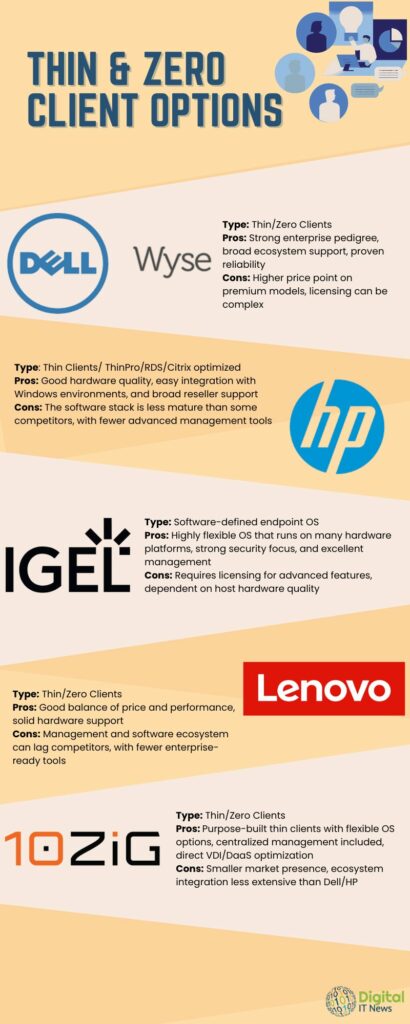
Dell (Wyse)
Dell’s Wyse thin and zero clients are among the most recognized PC-alternative endpoints on the market. While they come with a premium price, memory dependency, and complex licensing, they also carry trust in enterprise and government environments, offer broad protocol support, include security features, and provide global support. While they come at a premium price, they have impressive memory dependency and varied licensing options. Dell also carries a branded trust among enterprise and government environments due to their broad protocol support offerings, security features, and global support.
Existing Dell EMC infrastructure advantage:
Large enterprises that already use Dell EMC infrastructure will find this option the most appealing, as it will smoothly integrate with their current system.
HP Thin Clients
HP’s thin client portfolio includes hardware running Microsoft-optimized stacks and Linux-based options, often positioned for Windows Virtual Desktop and Citrix. They have software stack limitations, are less optimized for VDI than Dell, and have fewer OS choices compared to IGEL and 10Zig. That said, they do have some good things going for them. They have brand reliability and channel reach, they work well with Windows environments, and offer a wide range of hardware.
Existing HP hardware and Microsoft VDI compatibility advantage:
This option is best for organizations that have already invested in HP hardware and Microsoft VDI.
IGEL: Software-defined Endpoint OS
IGEL is best known for its secure, enterprise-grade endpoint operating system, IGEL OS, which transforms thin clients, PCs, and laptops into centrally managed endpoints. It’s a good choice for Enterprises that want security and flexibility above all, especially where the reuse of legacy hardware yields cost savings.
Operating system advantage:
IGEL OS is intentionally streamlined to remove unnecessary local agents and background services. This reduces on-device memory requirements, which is especially important when endpoints are deployed with constrained RAM due to market conditions.
Lenovo Thin/Zero Clients
Lenovo offers a range of thin and zero clients designed to support VDI environments, often positioned as a cost-effective option. This company is best suited for mid-market organizations with straightforward VDI needs and budget constraints that don’t require advanced orchestration.
Price advantage:
Lenovo’s competitive pricing for mid-range deployments makes it ideal for organizations with tight budgets.
10ZiG
10ZiG has built its reputation on purpose-built thin and zero-client hardware, spanning task-worker models to high-performance quad-display devices. Its hardware-first strategy, combined with OS flexibility, offers value for organizations seeking a single vendor for endpoint hardware and operating system or those looking to repurpose existing thin clients. It’s especially worth considering for those who value flexibility without additional software licenses.
Memory advantage:
10ZiG devices are designed to rely on centralized servers for most processing and memory usage. This significantly reduces dependence on large local memory modules, which is an advantage in a market where memory costs are rising, and availability remains inconsistent.
Final Thoughts
In a period defined by memory constraints, supply volatility, and rising PC costs, thin and zero client strategies might offer a practical and resilient path forward. Platforms with modern endpoints may no longer need memory-heavy PCs to meet enterprise performance and security demands. We will see if these alternatives to PC memory become the new norm or if the memory crisis the industry is currently facing is shorter-lived than predicted.
More Endpoint News
Related News:
2026 Endpoint Predictions for a Self-Defending Enterprise
Recast Right Click Tools Updated to Boost Endpoint Management
10ZiG Boosts Endpoint Security with Advanced FIDO2 Authentication Support