
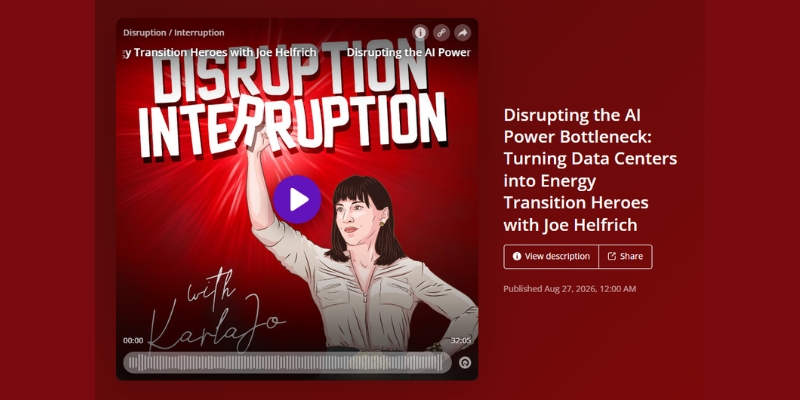
U.S. data center electricity demand is expected to increase sharply as AI adoption accelerates, placing growing pressure on the nation’s energy infrastructure. On an episode of Disruption Interruption, host Karla Jo Helms speaks with Joe Helfrich, Managing Partner and Co-Founder of NosTerra Venture Capital, about how rising AI compute requirements are challenging power generation, transmission, storage, and cooling capacity. The discussion also explores how data center growth could drive energy innovation and how investors can distinguish viable infrastructure technologies from AI hype.
Why AI’s Power Problem Is Bigger Than Data Centers
For Helfrich, the AI infrastructure problem starts with physical limits of the energy system. Data centers consume a great deal of electricity, cooling, and grid capacity to turn energy into compute. As AI workloads grow, the pressure moves beyond the technology sector and into the systems that generate, move, store, and use power.
That pressure is why server facilities are often cast as energy villains. They can strain local grids, increase electricity demand, require heavy cooling, and raise concerns about water use and local resource competition. Helfrich argues that this framing captures only part of the picture.
“Data centers really could be a challenge to energy innovation,” Helfrich says. “We take a contrary view and think this is a unique opportunity.”
The issue will become more complicated as AI moves from centralized model training to real-time use by people, devices, and machines. That will require compute to happen closer to the end user because delays of even milliseconds can matter in applications such as autonomous vehicles, industrial systems, and machine-to-machine communication. “They’re not going to wait for that inference to go across the country,” Helfrich says.
Investing in the Physical Layer of AI
Helfrich sees AI’s power crunch as an opening for companies solving real problems across the energy chain: generation, transmission, storage, and the way data centers use power.
“It’s going to be an all-of-the-above solution,” he says. “Data centers are really just factories that take energy and convert that into compute.”
That view shapes how NosTerra evaluates companies. Helfrich says the fund looks for technologies solving urgent infrastructure problems, not incremental improvements that get lost in the noise. A solution that delivers a small efficiency gain may be useful, but the strongest opportunities are the ones that can materially change capacity, cost, or speed to market. “We look for these mind-blowing, out-of-the-box opportunities,” he says.
One example is a Boston-area company out of MIT that uses carbon-capture technology inside modular edge data centers. Helfrich says the system improves cooling efficiency while producing beverage-grade CO2 as a byproduct, which can then be sold to bars and restaurants. That revenue can help support the economics of the facilities powering AI workloads.
“It’s that crazy out-of-the-box thinking,” he says, “solving two problems at one time.”
For Helfrich, the same pressure that makes data centers controversial could also make them useful. The demand for compute creates customers, urgency, and capital for energy technologies that might otherwise move slowly.
“This is not about AI,” Helfrich says. “These innovations can make energy more abundant, resilient, and available across the economy.”
Links
Disruption Interruption is the podcast where you will hear from today’s biggest Industry Disruptors. Learn what motivated them to bring about innovation and how they overcame opposition to adoption.
Related News:
Black Duck Signal MCP Server Brings Vulnerability Detection to Claude