
LinuxGuard exists to give every organization complete visibility into its Linux identity posture — every identity, every privilege, every connection, known, governed, and continuously assured. Linux is the foundation of the modern enterprise. It deserves the same rigor applied to every other critical system.
Can you share the most interesting story that happened to you since you started your career, especially one that shaped your leadership approach at your current company?
Early in my sales career, I was brought in on a business-critical outreach campaign to establish vital new markets for the company. The team had already tried it and essentially given up; the easy conclusion was that the market wasn’t there.
I genuinely believed in the product and what it could do for the organizations we were approaching, and that belief drove everything. Rather than accept the easy conclusion, I treated it as a process problem and looked at where it was breaking down. Three things stood out: the message wasn’t strong enough, it wasn’t being delivered with conviction, and the wrong people were being targeted.
I rebuilt the messaging to be concise and clearly valuable, put together a verified list of the actual decision makers, and then worked the phones to book the majority of that list onto a webinar, the next stage of the sales process. A significant number went on to become clients, which confirmed the diagnosis. Many of the decision makers I contacted later thanked me for bringing the opportunity to them.
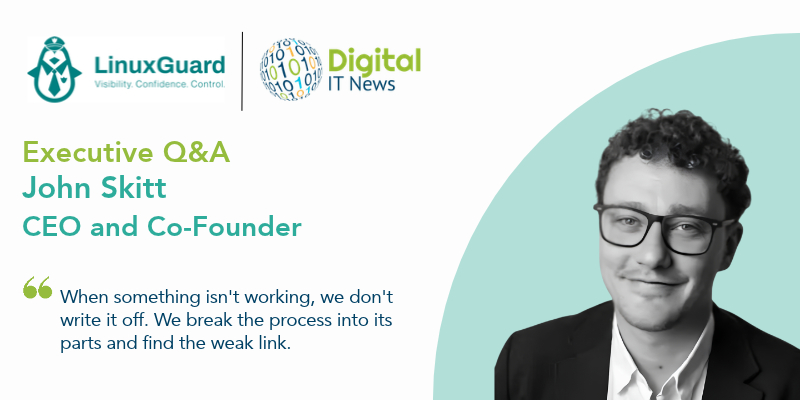
That experience shaped how I lead at LinuxGuard. When something isn’t working, we don’t write it off. We break the process into its parts and find the weak link. It also set a standard I hold us to: if the message genuinely improves how someone and their organization operate, and it reaches the right people delivered with conviction, then growth follows. When results don’t come, that tells us where to look, not that it’s time to stop.
What initially brought you to this specific career path, and how did it lead to your role in this company?
I met Peter just after leaving university. He was already well into his career in identity and access management (IAM), and I admired his work ethic and entrepreneurial spirit. We kept in touch over the next 15 years or so, and even collaborated on a start-up idea while I was still early in my sales career.
Since then, I’ve been lucky enough to work in, and contribute to, a number of high-growth environments. I’ve also spent time with organizations that were struggling to grow. Seeing both sides taught me what drives success and what holds it back, and the skills and experience I picked up along the way gave me real confidence in finding paths to growth.
So when Peter introduced the idea for LinuxGuard, it felt like the right opportunity: a chance to put those skills and that experience to work alongside a business partner I trust and respect.
What makes your company stand out from competitors in the market? Can you share an example that highlights this?
We want LinuxGuard to be boring. Not because the problem is small, but because good security rarely draws attention to itself. It sits in the background, reduces risk day after day, and only speaks up when something needs fixing.
The problem it addresses exists in most organizations. Windows, cloud and SaaS identities are typically governed and reviewed. Linux, which much of the modern enterprise runs on, often isn’t held to the same standard. Years of deployments, migrations and emergency fixes leave behind admin rights, access keys and accounts that nobody remembers granting.
None of it is malicious, but together it builds quiet paths to the most sensitive systems, and it sits outside what most security tools were designed to look at.
Our job is to bring Linux identity security up to the same standard as everything else. We don’t ask organizations to replace what they already have. LinuxGuard integrates seamlessly with their existing IAM stack, closing the Linux gap rather than adding another silo. No flash, no bells.
LinuxGuard maps who can do what across a Linux estate, flags changes as they happen, and shows teams which gaps to close first. In one design partner deployment at a global payments firm, LinuxGuard found 247 orphaned accounts across a 412-server estate, and 83 NOPASSWD sudo rules were removed after the first privilege map.
Are you working on any exciting new products or projects? How do you think this innovation will positively impact your customers?
Our main focus right now is LinuxGuard Access, which is going live now. Until now, LinuxGuard has focused mainly on visibility: showing organizations who can do what across their Linux estate and flagging changes as they happen. Access takes the next step, from seeing identities to managing them.
It connects Linux to the directory an organization already uses, whether that’s Active Directory, Entra ID or a mix of both, so the identities that govern the rest of the business govern Linux too. It centralizes admin rights, manages SSH access, and grants just-in-time access that expires automatically instead of leaving standing credentials behind.
AI agents are treated the same way, with approval-gated, time-limited access rather than permanent keys. It’s also built so that servers keep working if LinuxGuard itself is unavailable, with emergency access always within reach.
The demand came directly from the market. We were speaking with organizations running several hundred Linux servers and workstations with no identity management in place, who wanted Linux tied to their directory for sign-in, admin rights and general security.
For customers, the result is end-to-end identity management on Linux: one platform to see who has access, decide who should, grant it when it’s needed and remove it when it isn’t. It brings Linux up to the same standard as the rest of their environment, and keeps it there.
What was the tipping point for your company’s recent success? Was there a change in strategy or approach that others might learn from?
Early on, we tried what had worked for us in the past: a light marketing site, backed by targeted outbound, mainly by phone and LinkedIn. It brought some results, but not enough. Those approaches were quick to get going, but they weren’t the right foundation.
The tipping point was accepting that what worked before doesn’t work now, and that’s a good thing. Buyers expect far more information up front. They want to understand the problem, the product and how it fits their environment before they ever speak to a vendor.
That has been our mandate since. If there’s information we can make publicly available to help people reach their own decisions, and only come to us when they need to, then we publish it. We still run outbound, but the people we contact now have a growing body of material to draw on alongside our outreach.
The conversation starts from a much stronger place. Since the change, we’ve seen a 100% quarter-on-quarter increase in top-of-funnel pipeline.
The lesson for others is that doing things properly beats the quick fix, even when the quick fix gives you the feeling of moving sooner. Giving buyers what they need to make their own decisions builds trust that outreach alone can’t.
Can you share a significant challenge your company faced and how you overcame it? What key lesson did that experience provide?
Working closely with design partners was invaluable, but it came with a cost. We were still learning what mattered most to companies, and in trying to meet a range of requests, the product experienced some scope creep. By mid-2026, it was clear the architecture had suffered, and that a teardown was needed to support future growth.
It was a major undertaking. Rebuilding the core of a product is never something a young company takes on lightly. But without that work, LinuxGuard wasn’t set up to scale in the way we wanted, or in the way we’d need to in order to support our customers. So in summer 2026 we rebuilt it.
The work was painful, but vital. The key lesson was that the foundations matter more than the pace. Listening closely to customers is essential, but it has to sit on top of a product built to last. When the foundations are wrong, the right call is to fix them, even when it’s hard, rather than keep building on something that can’t carry you where you need to go.
In just a few words, what differentiates your leadership role from others in the company? What impact does this have on company culture or product success?
People first. That has been constant in every leadership role I’ve held, from Senior Patrol Leader in the Scouts through my teens, and team leader at Marks and Spencer, to hospitality team lead and sales management roles later in my career. Getting team dynamics right is vital if you want to achieve real success.
At LinuxGuard, that approach is balanced by what Peter brings. He shares a strong perspective on people and teams, and his deep and broad technical understanding and experience round out our founding leadership. I have enough technical understanding to challenge a position, and Peter brings the same from a business point of view.
That overlap is what makes the partnership work. We can collaborate properly, motivate each other, and hold each other accountable for our areas of responsibility. For the company, it means decisions are tested from both sides before they’re made, and the culture we’re building reflects that: open challenge, mutual respect, and people at the center of how we work.
For more information, visit: https://linuxguard.io/
Related News:
SecurityScorecard Launches First AI TPRM Benchmark
ControlUp Launches Pulse AI Resolve for AI-Powered IT Troubleshooting and Endpoint Remediation