
Functionize is an agent-native software testing platform. Global enterprises including GE Healthcare, McAfee, Markel, Geico and Alight rely on Functionize to build, run, and repair tests at scale, and to prove every release works as intended. As software gets easier to produce, quality is the distance between what a team intended and what actually reached their customers. Functionize aims to close it, on every release, for every team.
Can you share the most interesting story that happened to you since you started your career, especially one that shaped your leadership approach at your current company?
Before I founded Functionize, I spent years consulting and following markets closely, watching companies of very different sizes across very different sectors. The same pattern kept showing up. It is easy to miss in startups, where founder-led is the default. It is much more obvious in the public markets, where founder-led companies are the exception and they still tend to outperform. Founders carry a level of drive and accountability that is hard to hire for.
That shaped how I built Functionize. When we recruit, we look for natural builders and problem solvers who want impact and room to work across the problem. I set the direction as founder, and we keep the organization deliberately flat. That keeps us fast, and it puts the decision with the person closest to the problem.
What initially brought you to this specific career path, and how did it lead to your role in this company?
In college, I taught myself to code and began building web applications, which eventually led to launching my own software consultancy. While the firm was successful, I realized consulting wasn’t the model I wanted to build. What it did give me was a clear view of a gap nobody was closing. Nearly every tool on the market worked from the outside in.
They read static source code, or they targeted fragile UI selectors, and they were blind to how the application actually behaved at runtime. Move one button and an entire test suite breaks. What the market lacked was a live model of the application itself, one that knew what every element was, how it behaved, and how those behaviors changed release over release.
Testing was the way in. It has been chronically underestimated, which is exactly why the field stayed open. It is the only enterprise function that exercises a live application end-to-end on every single release. Every test execution is an observation. We started tracking every piece of data we could get on HTML elements and used every run to train and refine the model. For over a decade, we were not just running tests. We were compounding an understanding of how applications behave and are tested.
The arrival of AI coding agents turned that long-term bet into an urgent necessity. Code generation exploded, but verification couldn’t keep pace. The deep behavioral model we spent ten years building became the exact missing link required to close that gap.
What makes your company stand out from competitors in the market? Can you share an example that highlights this?
We committed to an agentic architecture and agents early, and Functionize Studio is the manifestation of that commitment: (Functionize Launches Studio, A Quality Platform Whose Adversarial Agents Prove Software Works as Intended).
Studio’s agents prove that software does what it was built to do. It was engineered from the ground up on a live model of the application rather than brittle selectors. Teams describe what needs to be verified in plain language. Studio then generates the tests against your web application, runs them in parallel across browsers, heals them as the UI changes, and surfaces only the failures that are real bugs rather than noise. It covers the enterprise stack, custom internal applications alongside platforms like Salesforce, Workday, ServiceNow, and SAP. That is how verification keeps pace with the way code is now written.
Are you working on any exciting new products or projects? How do you think this innovation will positively impact your customers?
With Functionize Studio gaining adoption, we are most excited to work on benchmarking. While the adversarial approach to build and train agents to give control over AI writing code is now in place, there is a very large gap today in companies’ ability to understand what is meant to be changed and the volume of change.
Currently, changes go from the product management layer, are rolled out to engineering, and then to AI agents. There might be hundreds of agents involved. That blind spot carries immense risk. To solve it, we are building a quantifiable benchmark for agents to be able to accurately measure agents’ ability to identify defects vs legitimate changes, so we can report transparently on what passed, what failed, and why. This provides leaders with two vital advantages: clear, quantifiable ROI on automation, and defensible, data-backed confidence when certifying a release for production.
What was the tipping point for your company’s recent success? Was there a change in strategy or approach that others might learn from?
The application model was the foundation, but the breakout came in 2020, when we committed to plain-language test authoring. At the time, that meant writing step-by-step instructions in natural language and training the platform to interpret them. It was hard early on, and it was the right architectural direction.
When the LLMs became mainstream, we did not have to scramble or pivot. The interface we had been arguing for was suddenly the one the whole industry was adopting, and the data model underneath it was ready to fuel it and take advantage of the rapid advancements in the industry.
The takeaway: place your durable bets on the substrate (your core data layer), and on the interface. Hold everything in between loosely. Middleware turns over fast. If the data layer and the interaction model are sound, every wave of new technology makes the platform stronger instead of forcing a rebuild.
Can you share a significant challenge your company faced and how you overcame it? What key lesson did that experience provide?
Our hardest problem was commercial, not technical. The AI boom reset what buyers expected, and our go-to-market engine was still calibrated for traditional enterprise software: long evaluation cycles, high-touch, heavy professional services.
Modern buyers want hands-on access immediately, value on day one, and the ability to prove out a proof of concept on their own terms. So we have evolved Functionize around product-led growth, which meant introducing pricing for self-serve onboarding and rapid product adoption.
The lesson is that when a market changes how it buys, that is a product problem before it is a sales problem. The fastest way to fix a go-to-market motion is usually to change what the buyer can do without you.
Leadership Impact: In just a few words, what differentiates your leadership role from others in the company? What impact does this have on company culture or product success?
I think of my primary role as chief explainer. I make the hard strategic calls, then make the reasoning behind them completely visible, so everyone understands why we are taking a path and how it connects to where we are going.
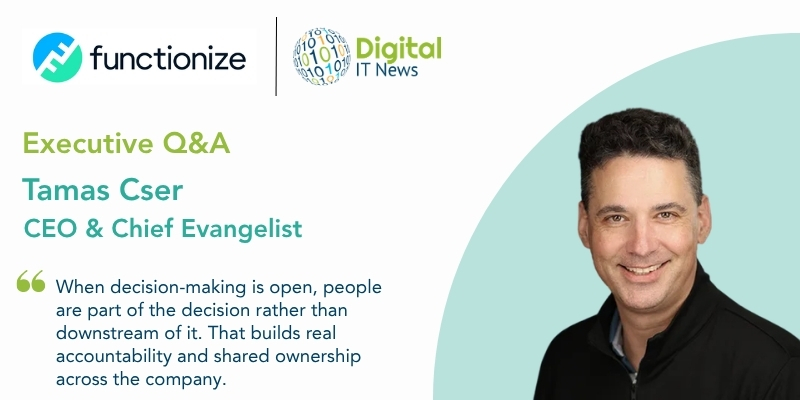
When decision-making is open, people are part of the decision rather than downstream of it. That builds real accountability and shared ownership across the company.
For more information, visit: https://www.functionize.com/
Related News: