

Enterprise storage strategies have progressed beyond exclusive object storage, now encompassing platforms that integrate both file and object storage. These solutions accommodate traditional file-based workloads (NFS/SMB) as well as modern S3-compatible object storage, allowing organizations to consolidate data management across applications, analytics, and hybrid cloud environments.
This analysis examines the top 10 enterprise file and object storage platforms, highlighting their optimal use cases, strengths, and trade-offs.
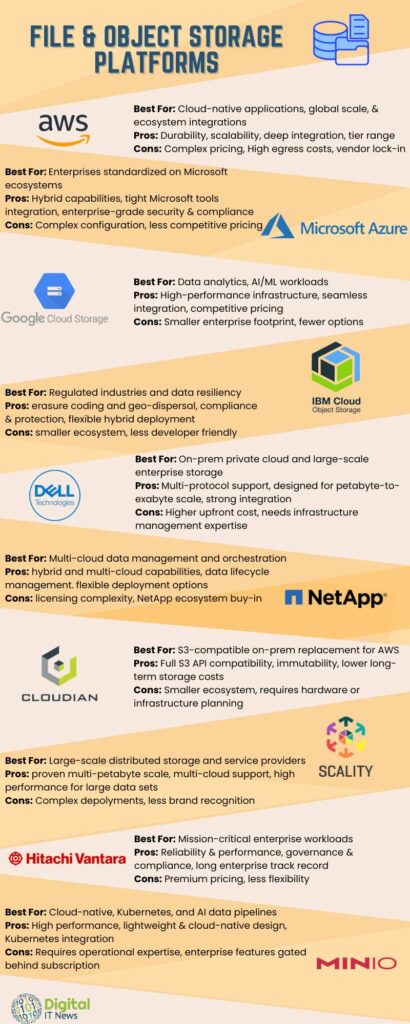
Amazon Web Services: Amazon S3 & EFS
Amazon Web Services provides both object storage (S3) and file storage via Elastic File System (EFS), regarding it as a strong choice for cloud-native and hybrid workloads. It is particularly suitable for entities seeking global scalability and effortless integration with cloud services. Key strengths include high durability, an extensive ecosystem, and flexible storage tiers. However, pricing complexity, high egress costs, and potential vendor lock-in are major limitations.
Microsoft Azure Blob Storage & Azure Files
Microsoft delivers a unified solution through Blob Storage for object data and Azure Files for managed file shares. This platform is well-suited for enterprises with existing Microsoft investments, delivering seamless integration with enterprise tools and strong hybrid capabilities. Advantages include robust security and compliance features, though configuration complexity and potential cost escalation at scale are important considerations.
Google Cloud Storage & Filestore
Google integrates high-performance object storage with managed file services via Filestore. This platform is especially effective for analytics, AI, and high-throughput workloads.
Dell Technologies: PowerScale & ECS
Dell delivers an extensive combination of file storage (PowerScale, formerly Isilon) and object storage (ECS). This platform is optimal for large enterprises managing extensive unstructured datasets on-premises or within private clouds. It delivers high scalability and multi-protocol support, though it calls for substantial upfront investment and operational expertise.
IBM Storage Scale & Cloud Object Storage
IBM provides both file (Storage Scale, formerly GPFS) and object storage solutions customized for high-performance and regulated environments. This platform is well-suited for industries with exacting compliance and resilience requirements. Key strengths include advanced data protection and hybrid deployment capabilities, though its ecosystem and developer experience may be less streamlined than hyperscalers’.
HPE Ezmeral Data Fabric
HPE’s Data Fabric delivers unified file and object storage, highlighting support for analytics and AI workloads. It is particularly appropriate for enterprises constructing data lakes or edge-to-cloud architectures. Strengths include scalability and flexibility, while deployment complexity and cost may cause challenges.
Hitachi Content Platform & NAS
Hitachi Vantara’s platform is best applied in mission-critical environments where reliability, performance, and strict regulatory compliance are essential, such as finance, healthcare, and government workloads. Its strengths lie in robust data governance, strong durability, and consistent high performance, making it a dependable choice for enterprises with stringent requirements. However, these advantages come with trade-offs: the platform is often more expensive than competing solutions and offers less cloud-native flexibility than newer, cloud-first storage platforms. These factors may limit agility in modern application environments.
Scality RING & ARTESCA + File Integration
Scality delivers object storage with integrated file access capabilities. It targets extensive deployments and service providers. It is especially effective for organizations that require distributed storage at a petabyte scale. Strengths include performance and flexibility, while deployment complexity and the requirement for specialized expertise are notable considerations.
MinIO S3 Compatible
MinIO is a cloud-native object storage platform that can be extended to support file workloads through gateways and integrations. It is particularly well-suited for Kubernetes environments and modern data pipelines. The platform offers exceptional performance and simplicity, though it requires operational maturity and may lack certain traditional enterprise file features.
What To Consider Before Choosing a Platform
The transition to unified file and object storage reflects the developing approach enterprises take to data management across hybrid, multi-cloud, and analytics-driven environments. Leaders like Amazon Web Services, Microsoft, and Google lead in cloud scale and innovation.
- Traditional vendors, including NetApp, Dell Technologies, and IBM, maintain dominance in hybrid and enterprise-controlled environments.
- Emerging and specialized platforms, such as Scality and MinIO, provide flexibility and high performance for modern workloads.
Most enterprises implement a combination of these platforms, aligning file and object storage strategies with workload requirements, compliance obligations, and long-term cost optimization.
More Storage News
Related News:
Comparing Today’s Leading DEX Platforms
A PC Alternative Endpoint Showdown in a Memory-Constrained World