
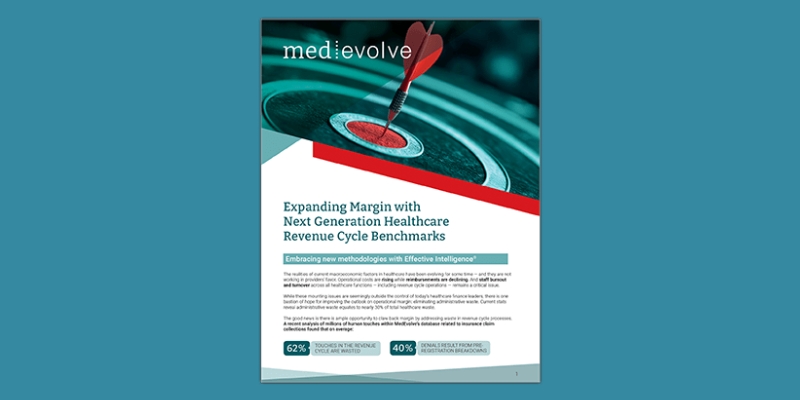
As healthcare organizations expand their use of AI, MedEvolve cautions that measuring automation by tasks completed rather than financial outcomes may increase administrative inefficiencies instead of reducing them. While nearly two-thirds of healthcare providers now use AI in revenue cycle management, many organizations continue to evaluate success based on activity instead of payment performance, highlighting the need for outcome-focused automation strategies.
David Henriksen, CEO of MedEvolve, believes that approach creates a dangerous blind spot. When AI automates inefficient workflows without measuring their financial impact, it can accelerate denials, administrative rework, and delayed reimbursement instead of eliminating them. “None of those metrics ask the only question that matters: Did this action get you paid?” Henriksen said. “Automation that doesn’t answer that question doesn’t remove the tax. It just makes mistakes cheaper and faster to produce.”
Automating the Wrong Work
Artificial intelligence is expanding rapidly across coding, eligibility verification, prior authorization, claim status, and billing workflows. While these technologies can complete individual tasks faster than people, completing a task does not necessarily improve the financial outcome. Henriksen points to automated coding as one of the clearest examples.
“A bot can send a claim out the door in two seconds, but if it missed a modifier or selected the wrong payer, that claim may come back denied six weeks later,” Henriksen said. “Now it takes three or four human touches to fix what the machine broke The task succeeded. The outcome failed.”
The same issue extends beyond coding. Claim status bots can check thousands of claims each day, creating the appearance of higher productivity. But if those checks do not move claims closer to payment, organizations may simply be automating motion instead of progress.
AI Must Be Measured by Outcomes, Not Activity
As healthcare organizations face workforce shortages, increasing denial complexity, and mounting financial pressure, Henriksen argues that automation should be judged by its impact on reimbursement rather than activity alone.
Removing one human touch does not necessarily eliminate work. If that same claim later requires payer follow-up, documentation requests, appeals, or claim corrections, the administrative burden has simply shifted elsewhere. MedEvolve refers to this hidden burden as the Touch Tax: the cumulative cost of human and AI-generated work that fails to produce a financial outcome.
According to MedEvolve’s analysis, 65% to 85% of human touches in the revenue cycle produce no financial outcome, depending on the organization. Henriksen said early observations suggest AI alone does not improve that ratio because it often performs the same non-actionable work faster unless it is guided by outcome-based data.
“We’re seeing automation complete work more efficiently, but efficiency isn’t the same as effectiveness,” Henriksen said. “If AI is performing the same non-actionable work people were already doing, you’ve accelerated the process without improving the outcome.”
Henriksen cites a case in which a $635 claim required six or seven touches before it was paid, with each interaction costing an estimated $5 to $10 in labor. A comparable clean claim for the same amount was paid after just a single touch.
“Same reimbursement. Completely different cost to collect,” Henriksen said. “One protected the organization’s margin. The other consumed it. That’s the hidden cost of touches in RCM management.”
Rethinking How AI Success Is Measured
Organizations often evaluate artificial intelligence using measures such as claims processed, task completion rates, automation percentages, and processing speed. Henriksen believes those metrics can create a false sense of progress because they reveal little about whether AI is actually improving financial performance.
To address this challenge, MedEvolve developed a framework of touch-level operational indicators designed to measure the work behind reimbursement. Rather than focusing only on productivity, it helps organizations identify administrative friction, avoidable effort, and workflow breakdowns before they appear in financial reports. The framework emphasizes measures such as:
- Touches to resolution: The total effort required to move a claim from submission to payment.
- Avoidable touches: Administrative work that could have been prevented.
- Denial-related workload: Operational effort generated by payer friction and preventable denials.
- Payment outcomes: Whether automation actually improves reimbursement.
- Total cost to collect: Whether AI reduces overall administrative effort instead of shifting work elsewhere.
“Healthcare doesn’t need artificial intelligence that simply completes more tasks,” Henriksen said. “It needs artificial intelligence that improves payment outcomes. Organizations that measure outcomes instead of activity will be in a much better position to improve margins without scaling inefficient workflows.”
Read the full report here: https://medevolve.com/rcm-effective-intelligence/2025-revenue-cycle-benchmarks-report/
Related News:
Health Universe Partners with Atropos Health for Clinical AI
SonicWall Healthcare Protect Report Reveals Escalating Cyber Threats