
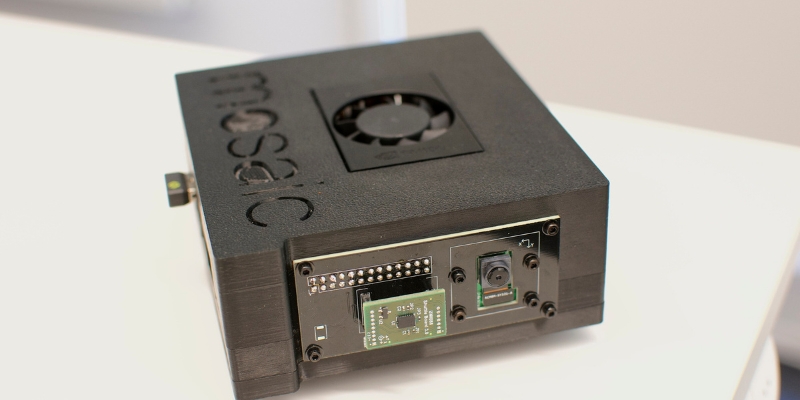
The next generation of consumer devices won’t just record the world, they’ll interpret it. Spatially aware AR glasses, continuous computer vision, and persistent AI all hinge on a capability most hardware still lacks: real-time perception within extremely tight power limits. Right now, achieving that typically requires power-intensive application processors and often GPUs, which makes truly wearable designs impractical. Mosaic SoC was created to address this gap by developing specialized perception chips that deliver spatial intelligence to devices with strict energy constraints.
The company announced a $3.8 million pre-seed round led by Founderful with participation from Kick Foundation.
Devices are gaining cameras and sensors faster than they’re gaining the intelligence to use them. The compute needed to interpret those signals still sits behind heavy processing stacks that drain batteries and force compromises in size, heat, and industrial design. For Original Design Manufacturers (ODMs) building next-generation AR and mobile hardware, adding more compute often means adding more complexity. Mosaic SoC takes a different approach: a dedicated perception chip that provides a baseline layer of spatial intelligence, with a full application layer that ODMs can integrate and build on top of.
“Spatial intelligence shouldn’t require an application-class processor and a GPU,” said Alfio Di Mauro, CEO and co-founder of Mosaic SoC. “We built Mosaic SoC to deliver real-time perception at a fraction of the energy, so battery-powered devices can understand their environment without compromising form factor.”
Mosaic SoC builds integrated circuits that process visual and positional sensor data to give devices a real-time understanding of where they are and what’s around them. The company describes it as turning space into signals. The Mosaic SoC chips are designed to be small enough and efficient enough to make smart glasses indistinguishable from regular glasses, while still delivering full spatial awareness. The goal is to unlock device form factors that until now simply weren’t viable.
The chip lets a device build a local map of its surroundings and the objects within them, enabling features like recalling where an item was last seen or generating a floorplan on the fly. In smartphones, Mosaic SoC can act as a co-processor for the front camera, running always-on tracking and classification at a fraction of the power. That means a device can trigger recording only when a specific event occurs or a certain object appears, delivering continuous awareness without draining the battery.
The company was founded by duo Moritz Scherer and Alfio Di Mauro, both PhDs from ETH Zurich with deep expertise in system-on-chip architecture. They identified a widening gap between demand for edge intelligence and what existing hardware could actually deliver. The business model is straightforward: the company sells integrated circuits. But what makes Mosaic SoC unusual is that adding its chip doesn’t add complexity for ODMs. It removes it. The chip ships with a full application layer that Mosaic SoC develops and maintains, so ODMs can integrate it and build on top of it rather than engineering perception capabilities from scratch. The ambition is to bring spatial intelligence to every device where it was previously impractical.
In its first year, Mosaic SoC has already generated meaningful revenue through NRE contracts with ODM partners. As its chips reach the market, the company expects its revenue profile to shift from engineering engagements toward scalable product revenues tied to chip sales.
Mosaic SoC’s core differentiation is architectural. Where competing approaches rely on single- or dual-core ARM-based designs, Mosaic SoC uses a proprietary multi-core architecture with eight or more cores, engineered to maximize performance per watt and make always-on perception viable in energy-constrained devices. But the company sees hardware as just the starting point.
Mosaic SoC is building AI deployment toolchains and compilers that let firmware developers fully leverage the architecture, with plans to evolve from a chip provider into a platform supplier where applications are developed, deployed, and optimized around its silicon.
Antonia Albert, Investor at Founderful, added: “The next billion smart devices will see and understand the world around them. Mosaic SoC’s product is the chip that makes that possible at scale. Moritz and Alfio have the architecture, the platform vision, and the team to make it happen. We are proud to back them with Founderful on their journey to define the spatial computing era.”
Looking ahead, Mosaic SoC’s goal is to become the standard layer for spatial intelligence at the edge, enabling always-on perception in wearables and mobile devices without the power and complexity tradeoffs that have held the category back.
Learn more about how spatial intelligence is shaping the future of low-power, real-time perception in next-generation devices at the Mosaic SoC website here.
Related News: