
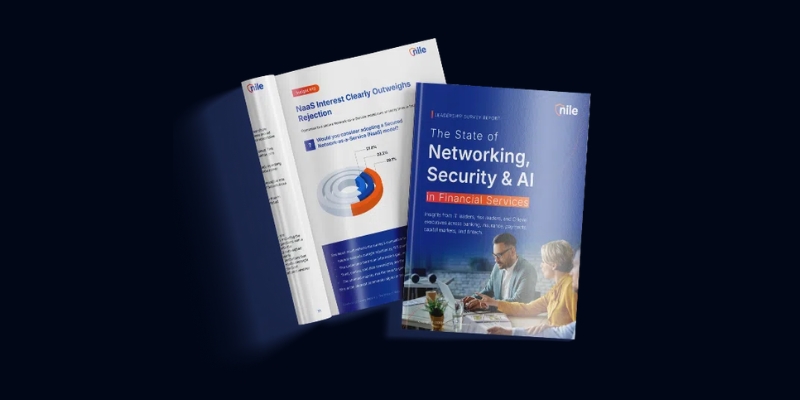
Nile has published a new research report, “The State of Networking, Security & AI in Financial Services,” based on a global survey of 322 IT, security and risk professionals across banking, insurance, payments, capital markets and fintech. The findings highlight growing industry pressure as organizations contend with security threats, regulatory requirements and rising network costs while seeking greater efficiency.
Cybersecurity and regulatory risk rank as the top ongoing network challenges at 24.2%, with rising operational costs close behind at 22.4%. When respondents considered what they would prioritize in a network redesign, they ranked lowering total cost of ownership first, at 25.2%, making this the first sector Nile has surveyed where economics outrank security as the top redesign priority.
Other State of Networking, Security & AI in Financial Services key findings include:
- Threat Detection Without Containment: Only 20.5% of organizations automatically detect and quarantine threats in real time. The remaining 79.5% rely on manual intervention, and struggle with limited visibility or delayed detection.
- Network Disruption Reaches the Customer: 57% experience monthly, or more frequent, network disruptions that affect customer transactions, trading activity, digital banking access or internal operations.
- Third-Party Access Remains a Critical Weakness: Only 21% fully segment third-party access with enforced policy controls, leaving nearly four in five institutions short of that standard.
- Audit Readiness Demands Significant Manual Effort: 59.3% report a moderate to significant manual burden to maintain audit readiness, while just 19% use automated reporting and policy enforcement.
- Zero Trust Adoption Stalls Before Enforcement: Only 18.6% fully enforce Zero Trust across their networks, with architectural complexity from legacy systems noted as the leading barrier to adoption.
- AI and Network-as-a-Service Gain Momentum: Nearly half of institutions (46.6%) already deploy AI-driven tools or plan to adopt them within the next 12–18 months, while 72.4% would consider a secure a Network-as-a-Service model.
“Financial services run on trust, and trust increasingly depends on the network, especially when any disruption or security failure can quickly impact customers and raise regulatory concerns,” said Shashi Kiran, CMO of Nile. “This research shows that institutions understand the need to modernize, but the complexity of their legacy architectures make it difficult to strengthen security without adding cost and manual effort. Financial institutions don’t need another layer of tooling. They need a fundamentally simpler architecture that builds security, automation and compliance into the network from the start.”
The research also reveals a wide variation in network maturity among the organizations surveyed. Only one in five reported advanced capabilities in any individual area, including automated containment, Zero Trust, audit reporting, third-party segmentation and continuous visibility. Just 1.9% demonstrated advanced capabilities across five or more of the seven measures examined.
Taken together, these findings suggest that many financial services institutions could benefit from a more unified architectural approach – one that supports greater automation and outcome-focused operations, while allowing internal teams to focus more on strategic priorities and compliance.
Related News:
Nile Unveils World’s Largest Campus Network-as-a-Service Deployment