
Network to Code is the global leader in network automation, helping enterprises modernize how networks are designed, deployed, and managed through data-driven automation. Powered by Nautobot, its open source Network Source of Truth and Automation Platform, the company delivers software, services, and expertise that improve network reliability, enhance security, reduce operational costs, and support complex multivendor environments.
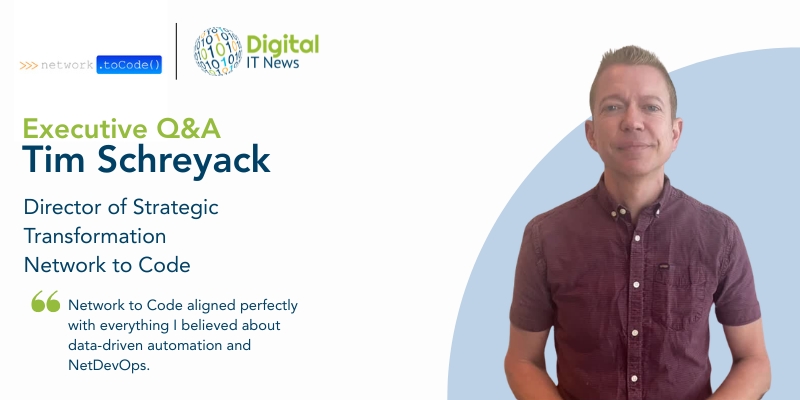
Tim Schreyack is Director of Strategic Transformation at Network to Code. An experienced network engineer who transitioned into software development and network automation, Tim helps organizations navigate their automation journeys and maximize the business value of modern networking technologies. Drawing on his expertise in network automation, software-defined networking (SDN), and digital transformation, he works with clients to design and implement strategies that improve operational efficiency, accelerate innovation, and support long-term business growth.
1. Career Journey: Can you share the most interesting story that happened to you since you started your career, especially one that shaped your leadership approach at your current company?
At Dell EMC I moved on from a principal network engineer role into software development in order to gain experience in automation in sales engineering. I spent the next few years teaching myself Python and Ansible to automate the exact tasks I had been doing by hand. Going from the most experienced person in the room to the one asking basic questions was humbling, but it gave me a perspective I carry into every customer conversation at Network to Code. I lived the transition our customers are trying to make.
2. Career Path: What initially brought you to this specific career path, and how did it lead to your role in this company?
After spending two decades in network engineering—from Dynamics Research, Monster, RSA, and Dell EMC—I pivoted into automation and sales engineering. The turning point was at Dell EMC, where I went from managing networks manually to writing code to automate them. That experience led me to a sales engineer role, and then to Network to Code (a leader in AI-powered network automation) in 2020. Network to Code was the first company I found that built an entire business around the principles I had come to believe in: data-driven automation, open source, and NetDevOps. For the last year and a half I have served as Director of Strategic Transformation, helping clients understand network automation’s value.
3. Company Differentiation: What makes your company stand out from competitors in the market? Can you share an example that highlights this?
Network to Code created commercial software applications to help enterprises automate network change at scale, validate outcomes, and retain evidence across complex multi-vendor environments. In addition, the team helps enterprises deploy automation in some of the world’s most complex network environments. That combination gives us a direct feedback loop most competitors don’t have: real-world customer challenges shape the product, and product innovation makes our services more scalable and repeatable.
A good example is NautobotGPT. We introduced it at ONUG’s AI Networking Summit with real-world customer results, and it was named Best in Show by ONUG. That recognition reflects what we’re building: practical, domain-specific AI grounded in Nautobot, NTC expertise, and production network operations.
4. Product Innovation: Are you working on any exciting new products or projects? How do you think this innovation will positively impact your customers?
Product innovation is a major focus for us. In April 2026, we launched Nautobot 3.1, an important milestone in Network to Code’s evolution into a more product-led, open-core software company. The release introduced OS Upgrades and Operational Compliance, two flagship commercial applications that help enterprise teams automate network change at scale, validate outcomes, and retain the evidence needed for governance and audit.
We’re also investing heavily in AI through NautobotGPT and the broader NautobotAI suite. These capabilities help engineers interact with network data in natural language, accelerate job creation, and work in tools like VS Code—helping newer users ramp faster while enabling experienced engineers to deliver more, with greater confidence.
5. Success Insight: What was the tipping point for your company’s recent success? Was there a change in strategy or approach that others might learn from?
The tipping point was our strategic shift from a services-led company to a product-led, open-core software company. The lesson is that open source and commercial software do not have to be in conflict. Nautobot’s open-source foundation gave us community trust, broad adoption, and more than 50,000 installs globally; our commercial applications give enterprises the packaged capabilities, governance, AI, SaaS delivery, and support they need to scale automation confidently.
That combination changed the business. In 2025, Network to Code grew recurring revenue 52%, and we are now using that momentum to accelerate commercial software innovation while continuing to develop and support Nautobot as open source.
6. Challenges and Lessons: Can you share a significant challenge your company faced and how you overcame it? What key lesson did that experience provide?
One of the most significant challenges we’ve seen is data quality. Network automation projects rarely stall because teams lack automation tools; they stall because critical network data is scattered across spreadsheets, stale CMDBs, IPAM systems, controllers, and tribal knowledge. When those systems disagree, automation becomes fragile, and teams spend more time reconciling data than delivering outcomes.
By making Nautobot the trusted Source of Truth, with SSoT integrations and data validation, they tackled the hardest part of network automation.
7. Leadership Impact: In just a few words, what differentiates your leadership role from others in the company? What impact does this have on company culture or product success?
My role is to translate technical depth into business outcomes. Leading the sales engineering function gives me a direct role in connecting customer needs, field experience, and product strategy to empower every network engineer to become an automation engineer and help shape the future of network operations.
To learn more about network automation at Network to Code, visit the website here.
Related News: