
Ecommerce fraud has evolved beyond stolen credit cards and fake transactions into a sophisticated threat that affects every stage of the customer journey. Easily accessible AI tools are helping criminals execute larger, faster and more advanced attacks while also making consumer-driven, first-party fraud easier to commit.
New data from Signifyd’s State of Fraud Report 2026, based on transactions across Signifyd’s Commerce Network of thousands of online merchants and 950 million unique digital wallets, found that ecommerce fraud pressure increased 33% year over year during the first four months of 2026, marking a significant acceleration in the pace of online fraud.
“For years, retailers and financial institutions have viewed fraud as a checkout problem. That assumption no longer holds,” said Raj Ramanand, co-founder and CEO at Signifyd. “Ecommerce is entering a new operating environment where AI is accelerating both innovation and fraud. Responding to this shift requires rethinking how trust and identity are established across every customer interaction. In this new autonomous commerce era, protecting revenue and preserving the customer experience have become the same business challenge.”
What does modern ecommerce fraud look like?
The report’s findings showcase a fundamental change in the economics of ecommerce fraud, with AI lowering the cost and complexity required to launch attacks while enabling fraudsters to operate at greater speed and scale than ever before. This new reality is illustrated in the report through true crime stories of stolen identities, copycat websites harvesting personal data and iPhone-fueled fraud and money laundering schemes.
The report uncovered specific risks, including:
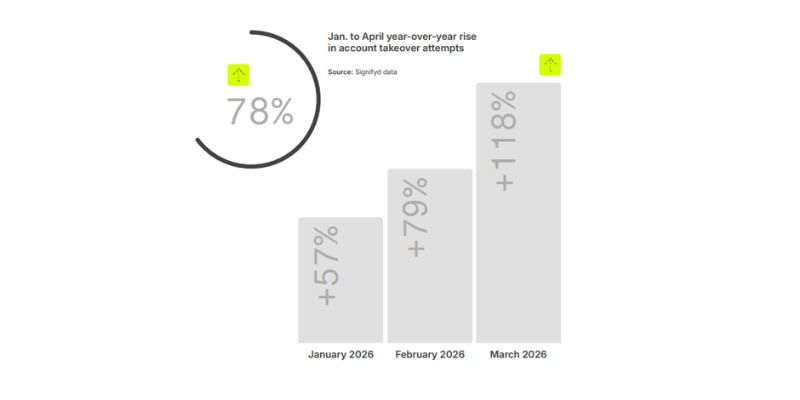
- Account takeover attacks increased 78% year over year, as fraudsters increasingly targeted trusted customer accounts.
- Card-testing attacks surged 175% year over year, enabling fraudsters to validate stolen payment credentials faster than ever before.
- BOPIS fraud increased 65% year over year, highlighting how fraud is extending beyond online checkout into fulfillment operations.
- First-party fraud and consumer abuse increased 9% year over year, underscoring the growing role of opportunistic abuse alongside organized criminal activity.
“What’s changing isn’t simply the volume of fraud, instead it’s the way fraud operates. Attackers are combining multiple tactics to maximize their success,” said Nicole Jass, SVP, enterprise strategy at Signifyd. “At the same time, we are at a unique moment when the line between organized fraud and consumer abuse continues to blur, creating a much more complex environment for retailers than we’ve seen in the past. “Understanding the who or what behind these threats and connecting the patterns across merchants will better fight the problem.”
This evolution in fraud tactics is forcing retailers to rethink how they manage risk across the business. Preventing fraud is no longer just about blocking bad orders; it means recognizing suspicious account activity before loyal customers are compromised, identifying fraudulent return claims without penalizing legitimate shoppers, and protecting revenue without creating unnecessary friction that drives customers away. The key factors retailers should consider include:
- Rethinking how trust is established online. As digital identities become the most valuable targets, retailers need to evaluate their authentication processes to minimize unnecessary friction.
- Preparing for the agentic commerce era. AI is accelerating both commerce and fraud; ecommerce will need to establish trust across both traditional customer interactions and emerging AI-assisted shopping experiences.
- Planning for fraud as an enterprise-wide challenge. Fraud affects customer experience, operations, and profitability, making cross-functional collaboration essential.
Read the full report here: “State of Fraud Report 2026: How AI has industrialized ecommerce fraud” here.
Related News:
The State of Biometric Security in the Age of AI Fraud Report Released
The €500 Million Red Flag: Why the Wise Investigation Means Banks Need Better Fraud Technology