
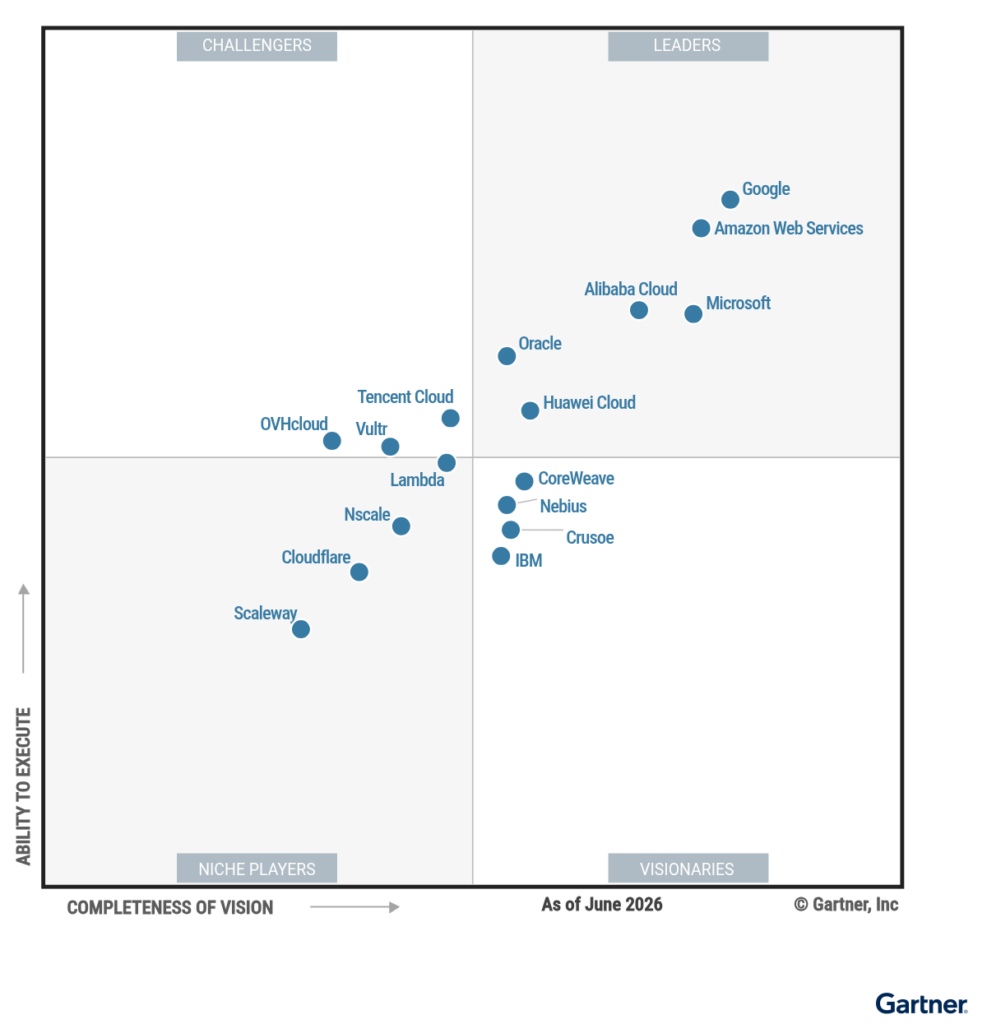
Cloud AI infrastructure has rapidly become the cornerstone for organizations scaling advanced AI workloads, driven by hyperscalers and specialized cloud providers that optimize compute, networking, and storage for training, inference, and emerging agentic AI systems. Gartner’s 2026 Magic Quadrant for Cloud AI Infrastructure highlights how this market is evolving around high‑performance accelerators, distributed architectures, and AI‑specific orchestration capabilities that go far beyond customary IaaS. Providers are now differentiated by their ability to deliver optimized environments for large‑scale model development, real‑time inference, and multi‑cloud AI operations, underscoring a pivot toward infrastructure purpose‑built for continuous AI activity.
A major force shaping this market is the explosive growth of AI‑optimized IaaS, which Gartner projects will reach $37.5 billion in end‑user spending by 2026, with inference workloads accounting for 55% of that spend. This realignment emphasizes how AI infrastructure is no longer dominated by training cycles. Instead, real‑time inference, powering chatbots, fraud detection, recommendation engines, and industry‑specific AI agents, is becoming the primary driver of demand. To meet these needs, cloud AI infrastructure must integrate GPUs, TPUs, AI ASICs, high‑speed interconnects, and storage vectorized for data movement, as CPU‑centric architectures increasingly struggle to support the scale and velocity of modern AI workloads.
Gartner emphasizes that cloud AI infrastructure needs to evolve to support agentic AI, which introduces autonomous, multistep workflows that modify system states and require deterministic guardrails, deep observability, and hybrid runtime control. By 2029, Gartner predicts that 70% of organizations running agentic AI in production will experience material service, security, or cost incidents due to insufficient runtime controls, demonstrating the need for layered architectures that enforce nonhuman identity management, intent‑based access controls, and separation between cognitive reasoning and deterministic execution. As enterprises adopt industry‑specific AI agents and distribute AI workloads across multiple clouds, cloud AI infrastructure will increasingly center on orchestration, transparency, and resilience.
Let’s look at the leaders in this magic quadrant and discover what Gartner has to say about them.
Google: AI Hypercomputer
Google’s Cloud AI infrastructure centers on its AI Hypercomputer, a unified, agent‑native stack designed to support large‑scale model training, ultra‑low‑latency inference, and emerging agentic AI workloads. It combines purpose‑built hardware such as TPU v8 systems, A5X bare‑metal instances with NVIDIA Vera Rubin NVL72, Axion N4A Arm‑based CPUs, and GCE 4th‑generation x86 VMs, all connected through the Virgo Network, Google’s high‑performance data‑center fabric engineered specifically for AI workloads. This hardware foundation is paired with advanced storage systems, enabling high‑throughput parallel data access for training and inference at scale.
Strengths: Scalable Compute Foundation and Integrated AI Hypercomputer
Google’s strengths center on its proprietary, scalable compute foundation built around custom‑designed TPUs, silicon engineered for Google DeepMind and optimized for massive distributed training and low‑latency inference, giving enterprises and researchers greater efficiency and independence from constrained NVIDIA supply chains. These TPUs are integrated into Google’s AI Hypercomputer architecture, which tightly couples TPUs and GPUs with high‑performance networking and storage systems, like Managed Lustre, to eliminate bottlenecks and accelerate large‑scale AI workloads. Gartner also notes that by 4Q25 Google controlled roughly one‑quarter of the world’s cumulative AI compute capacity, a footprint distinguished by its heavy reliance on proprietary TPU infrastructure alongside NVIDIA GPUs, positioning Google as one of the largest and most strategically differentiated owners of AI compute globally.
Weaknesses: Cost Complexity, Ecosystem Trade-Offs & Resource Availability
Google’s weaknesses in the Gartner assessment focus on cost complexity, ecosystem trade-offs, and resource availability. Google Cloud’s AI pricing spans multiple layers from Gemini Enterprise Agent Platform usage to generative model tokens, TPUs, GPUs, and AI Hypercomputer consumption, making total cost of ownership forecasting and chargeback governance difficult for enterprises running large, mixed workloads across both managed services and custom infrastructure. Gartner also notes that while Google’s TPU‑led strategy provides performance and supply advantages, organizations that optimize heavily for TPUs may face portability challenges, since achieving maximum performance often requires aligning tooling, runtimes, and engineering practices to Google‑specific infrastructure paths, complicating migration across heterogeneous or standardized multicloud environments. Finally, despite Google’s proprietary hardware footprint, access to high‑demand NVIDIA GPU instances can still be constrained, creating availability bottlenecks that disrupt large‑scale training timelines, stall innovation, and force enterprises into more rigid capacity planning to secure critical compute resources.
Amazon Web Services: Amazon Bedrock, SageMaker HyperPod, EC2, Outposts, and AI Factories
Amazon Web Services’ Cloud AI infrastructure is built around a broad, flexible ecosystem designed to support every stage of AI development, from data preparation and model training to high‑scale inference and enterprise deployment. AWS differentiates itself through its extensive choice of compute, offering NVIDIA GPUs, AWS Trainium for cost‑efficient training, and AWS Inferentia for high‑throughput inference, all integrated with high‑performance networking and scalable storage. This hardware foundation is paired with a mature software stack that includes Amazon SageMaker for managed model development, distributed training frameworks, and optimized inference runtimes helping enterprises operationalize AI at scale. AWS also emphasizes reliability and global reach, enabling organizations to deploy AI workloads across a vast footprint of regions and availability zones, making it a strong fit for enterprises that prioritize flexibility, operational consistency, and a wide range of AI infrastructure options.
Strengths: Global Platform, Enterprise Security Posure, Flexible Operational Model
AWS’s strengths in cloud AI infrastructure stem from its mature global platform, deep enterprise security posture, and flexible operational model. Its foundational cloud capabilities—spanning broad regional coverage, multi‑AZ resiliency, and robust compliance frameworks—give organizations confidence when deploying mission‑critical AI workloads that demand high uptime and strong data integrity guarantees. AWS further differentiates itself with hardware‑rooted isolation through the Nitro System and support for emerging governance standards, making it especially appealing for regulated industries that require strict security and responsible AI controls. Finally, AWS reduces operational overhead by offering multiple levels of managed AI infrastructure, from serverless foundation model access in Amazon Bedrock to large‑scale training environments in SageMaker HyperPod, allowing enterprises to choose how much infrastructure they want to manage while accelerating time to value for their AI initiatives.
Weaknesses: Performance Limitations, Complexity, & Standardization
AWS’s cautions center on performance limitations for ultralarge training, complexity in how its AI offerings are presented, and challenges in standardizing architectures across teams. Gartner notes that AWS’s networking and cluster design can introduce latency constraints for massive distributed training, meaning organizations using Trainium may face performance gaps that increase TCO, require deeper software optimization, and add environmental complexity compared to more vertically integrated competitors. At the same time, AWS’s broad but inconsistently messaged portfolio, spanning Bedrock, SageMaker HyperPod, EC2, Outposts, and AI Factories, can make it harder for enterprises to navigate the right path, often resulting in longer deployment cycles, reliance on costly consulting, and overengineered solutions. This abundance of overlapping service paths also complicates enterprisewide standardization, making it difficult for organizations to enforce common patterns and reference architectures when teams have so many divergent approaches to building and running AI workloads.
Alibaba Cloud
Alibaba Cloud focuses on delivering high‑performance, cost‑efficient compute paired with a deeply integrated ecosystem tailored to enterprises operating across Asia‑Pacific and globally. Its platform combines large‑scale GPU clusters, custom AI accelerators, and optimized networking with services such as PAI‑Elastic GPU and PAI‑DLC to support training, fine‑tuning, and inference for both foundation models and industry‑specific AI workloads. Alibaba Cloud also differentiates itself through strong data governance, compliance with regional regulatory frameworks, and mature hybrid‑cloud capabilities that help organizations run AI workloads across on‑premises and cloud environments with consistent security and control. This makes Alibaba Cloud a compelling option for enterprises seeking scalable AI infrastructure with strong regional performance, competitive pricing, and an ecosystem designed for rapid deployment of generative and machine learning applications.
Strengths: Full-stack AI Portfolio, Optimized Super Computing Platform & Open Source Innovation
Alibaba Cloud’s strengths lie in its unified full‑stack AI portfolio, its optimized supercomputing platform for large‑scale workloads, and its strong commitment to open‑source innovation. The company provides an end‑to‑end suite of AI infrastructure services, from high‑performance raw compute to specialized development platforms and pretrained foundation models, making it attractive to enterprises seeking a single, integrated provider. Its PAI‑Lingjun supercomputing platform, engineered for heterogeneous large‑scale training and inference, delivers the low‑latency, high‑efficiency performance required for demanding AI applications and is validated by Alibaba’s own advanced production workloads. Complementing this, Alibaba Cloud invests heavily in open‑source technologies such as EasyNLP, EasyCV, PAI‑DSW, SRv6, and SONiC. Its Qwen open‑weight models rank among the most widely adopted globally. This combination appeals to organizations seeking technological sovereignty, strong community support, and reduced dependence on proprietary vendor ecosystems.
Weaknesses: Usability, Hardware Access Limitations & Regulatory Considerations
Alibaba Cloud’s cautions center on usability complexity, hardware access limitations, and regulatory considerations. Some Gartner users report that Alibaba Cloud’s interface and documentation present a steeper learning curve than U.S. hyperscalers, potentially slowing project ramp‑up or requiring staff with specialized expertise. Although Alibaba has invested in proprietary technology, embargoes restrict access to certain cutting‑edge AI accelerators, which may create performance gaps for enterprises needing the latest GPU or specialized hardware. Additionally, organizations in highly regulated sectors such as healthcare or finance must carefully evaluate data sovereignty and compliance implications when storing sensitive information on a Chinese‑owned cloud provider, as regional regulations may impose stricter governance requirements before adoption.
Microsoft Azure
Microsoft Azure is built around a deeply integrated, enterprise‑grade stack that spans custom silicon, high‑performance networking, and a mature software ecosystem designed to support both frontier‑scale training and production‑ready AI deployment. Azure combines NVIDIA GPU clusters, AMD MI‑series accelerators, and its own Maia AI accelerators with ultra‑low‑latency networking and global data‑center reach, giving enterprises a flexible foundation for large‑scale model development. This hardware is tightly coupled with Azure AI Studio, Azure Machine Learning, and the broader Copilot ecosystem, enabling organizations to build, fine‑tune, govern, and operationalize AI workloads with strong security, compliance, and identity controls. Microsoft’s long‑standing enterprise relationships, regulatory certifications, and hybrid‑cloud capabilities further strengthen its position, making Azure a leading choice for organizations that need reliable, secure, and globally distributed AI infrastructure.
Strengths: Solution Integration, Generative AI Ecosystem & Managed Services
Microsoft’s strengths in cloud AI infrastructure stem from its deep integration across the broader Azure ecosystem, its access to cutting‑edge generative AI technology, and its comprehensive managed services that streamline enterprise AI operations. Its tightly connected AI solutions make it easy for organizations already invested in Azure to quickly build and deploy AI‑driven applications, reducing friction and accelerating time to market. Through strategic partnerships, Microsoft provides customers with immediate access to advanced GenAI capabilities, giving enterprises a fast path from innovation to production. Complementing this, offerings like Microsoft Foundry and Azure AI Landing Zones deliver preconfigured architectures and simplified MLOps workflows, reducing operational overhead and minimizing the specialized skills required so teams can focus on model development rather than infrastructure management.
Weaknesses: Capacity, Maturity & Price Complexity
Microsoft’s weaknesses include capacity pressure, processor maturity, and pricing complexity. Like other hyperscalers, Azure continues to face sustained demand for AI compute, creating regional capacity constraints that require enterprises with large‑scale training or high‑throughput inference needs to secure explicit commitments before deployment. While Microsoft’s Maia processors improve inference efficiency, they currently play a more limited role in model training, meaning Azure still relies heavily on third‑party accelerators for the most compute‑intensive workloads. Additionally, Azure’s expansive and layered service catalog can make cost forecasting and governance challenging for complex AI pipelines, requiring enterprises to carefully evaluate TCO and establish strong optimization and governance practices as deployments scale.
Oracle Cloud Infrastructure: OCI
Oracle’s cloud AI infrastructure is built around a tightly integrated, enterprise‑focused stack designed for organizations that prioritize data governance, performance consistency, and deep integration with existing Oracle workloads. Its AI capabilities are anchored in Oracle Cloud Infrastructure (OCI), which offers high‑performance GPU clusters, RDMA‑optimized networking, and autonomous database services that streamline data preparation and model deployment. Oracle differentiates itself through strong support for mission‑critical enterprise applications, enabling customers to embed AI directly into ERP, HCM, and industry‑specific systems with predictable performance and security. Combined with OCI’s global footprint, built‑in compliance, and hybrid deployment options, including Oracle Alloy and Cloud@Customer, Oracle provides a stable, governance‑ready foundation for enterprises modernizing core business processes with AI.
Strengths: Scalability, Flexible Deployment, Enterprise Integration
OCI’s strengths include high‑performance OCI Supercluster architecture, flexible deployment options, and deep enterprise integration. The Supercluster’s ultra‑low‑latency networking and massive‑scale interconnects enable highly efficient multinode GPU training and distributed model serving, making it well‑suited for foundation model development and other demanding AI workloads that require rapid iteration and accelerated time to market. Oracle also offers extensive distributed cloud choices, allowing enterprises to meet strict sovereignty, regulatory, and low‑latency requirements. Finally, OCI’s native integration with Oracle Fusion Applications, the Autonomous Database, the AI Data Platform, and existing enterprise data stores streamlines AI adoption by reducing integration complexity and enabling organizations to quickly realize business value through intelligent, automated processes built directly into their core systems.
Weaknesses: Smaller, Maturity & Support Experience
The cautions for OCI center on ecosystem size, tooling maturity, and support experience. Compared to larger hyperscalers, OCI has a smaller pool of third‑party AI integrations and community resources, which can limit plug‑and‑play options and increase reliance on custom development or Oracle Consulting, ultimately extending time to market and raising implementation complexity. While the underlying OCI Supercluster infrastructure is strong, the surrounding AI management tooling, such as Kubernetes support and observability, remains less mature and may require enterprises to integrate third‑party solutions or build custom orchestration and monitoring capabilities. Additionally, Gartner clients report that OCI’s documentation can be fragmented and customer support response times inconsistent, creating friction for teams navigating complex AI configurations and potentially slowing issue resolution, debugging, and overall project timelines.
Huawei Cloud
Huawei Cloud emphasizes high‑performance compute, strong integration with Huawei’s broader technology ecosystem, and a focus on sovereignty‑aligned cloud services for global enterprises. Its Ascend AI processors and heterogeneous computing architecture provide scalable training and inference performance, supported by optimized networking and storage designed for large‑scale distributed AI workloads. Huawei Cloud also differentiates itself through its “Everything as a Service” strategy, offering tightly integrated AI development platforms, data governance tools, and industry‑specific solutions that streamline end‑to‑end AI adoption. Combined with its emphasis on security, regional compliance, and deployment flexibility, including options for localized cloud environments, Huawei Cloud positions itself as a compelling choice for organizations seeking performant AI infrastructure with strong alignment to data sovereignty and vertically integrated technology stacks.
Strengths: Full Stack, AI Life Cycle Support & Deployment Flexibility
Huawei Cloud’s strengths include its internally developed full stack, comprehensive AI life‑cycle support, and strong hybrid deployment flexibility. By pairing its self‑developed Ascend NPUs and Kunpeng processors with the CANN optimization suite and the MindSpore framework, Huawei delivers a vertically integrated hardware‑software stack that enables deep optimization, faster training times, and strong cost‑performance for large‑scale AI workloads. Its broad product portfolio supports the entire AI life cycle through ModelArts, an industry AI foundry that provides pretrained Pangu models, specialized datasets, agent development platforms, and CloudMatrix for large‑scale training and inference, allowing enterprises to consolidate vendors and simplify MLOps. Huawei Cloud also offers robust hybrid and private cloud options, enabling organizations to deploy AI infrastructure in public regions or on‑premises to meet strict data sovereignty, regulatory, and low‑latency requirements.
Weaknesses: Geopolitical Constraints, Proprietary Ecosystem Lock-in & AI Footprint
The weaknesses that Gartner found at Huawei Cloud include geopolitical constraints, proprietary ecosystem lock‑in, and a more limited global AI footprint. Ongoing geopolitical tensions and regulatory scrutiny restrict adoption in Western markets, creating supply‑chain and compliance risks for multinational enterprises that may need costly multivendor strategies to maintain global consistency. Its reliance on the proprietary Ascend/MindSpore/CANN stack also increases the learning curve and TCO, requiring specialized skills and creating migration challenges for teams accustomed to industry‑standard frameworks like CUDA. Additionally, Huawei Cloud’s AI infrastructure footprint outside its core regions is less extensive than that of global hyperscalers, limiting low‑latency deployment options in key Western markets and potentially affecting time‑sensitive workloads such as real‑time customer interactions or fraud detection.
Related News:
Data Science and Machine Learning Platforms Magic Quadrant Leaders
2025 Magic Quadrant Leaders in Network Detection and Response
2025 Magic Quadrant For DEX Tools
More Cloud News