
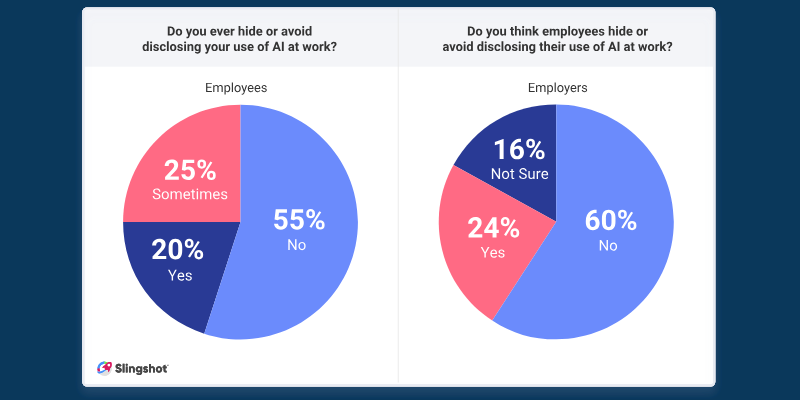
Slingshot, the work management platform from software company Infragistics that centers data across team workflows, has released Part 1 of its two-part Digital Work Trends Report. The findings show that even as workplace AI adoption grows, nearly half of employees (45%) are keeping their AI use hidden. While 47% of employers attribute this behavior to job security concerns, only 24% of employees agree. Instead, workers are more concerned about perception—34% worry AI use will be seen as cutting corners, and 27% fear judgment. These concerns are most pronounced among Gen Z employees (ages 18–28), nearly half of whom say they conceal AI use due to fears of being judged (47%) or viewed as taking shortcuts (44%).
Slingshot’s Digital Work Trends Report explores employer and employee sentiment around AI in the workplace, examining how it’s used, perceptions of AI transparency and how personal AI use differs from use at work. The new research also offers a look into how employers and employees differ in their approach to AI, and how AI use and transparency differs across generations
The two-part report is based on research conducted by market research firm Dynata, on behalf of Slingshot.
Additional findings include:
- Employees are embracing AI on their own. Only 28%of companies say they require employees to use AI tools. Despite many businesses not mandating AI use, 87% of employees are using it voluntarily. Two-thirds (66%) of employees say they are curious about using AI, which shows that they see value in AI and are open to bringing it into their workflows–even if it’s not required.
- Many employees don’t feel the need to disclose AI use. Nearly half (45%)of employees don’t share they’re using AI because they don’t feel the need to disclose it. This can be because they see it as part of their normal workflow, it doesn’t affect work outcomes or there’s no official company policy they need to adhere to. Millennials (ages 29-44) (44%), Gen X employees (ages 45-60) (57%) and Boomers (ages 61+) (47%) don’t disclose their AI use primarily for this reason, while their Gen Z colleagues have more concerns about being judged.
- AI use at work is crossing into employees’ personal lives. While one-third of employees (33%) say they use AI more frequently (or solely) at work than at home, AI’s mainstream appeal is slowly working into employees’ personal lives. Thirty-one percent (31%) of employees say they use AI at work and at home equally, and 22%say they use AI more in their personal life than they do at work. Gen Zers (ages 18-28) are using AI in their personal life more than the office (36%), while Boomers (ages 61+) use AI more at work (46%).Millennials (ages 29-44) and Gen X workers (ages 45-60) both say they use AI equally in the office and at home (42% and 35%, respectively).
- Managers are leading AI maturity. Employees say they primarily use AI to check or improve their work (54%) and draft emails, reports and other written content (52%), but managers and higher-level executives have their sights set higher. They use AI for more strategic work, including analyzing team and business data (56%), conducting research (52%) and managing team priorities (47%). Companies’ use of AI in this way has had a significant impact on their go-to-market strategy: 68% say they have saved a week or more in their go-to-market process with the technology.
“Before companies can be fully AI-powered, they have to focus on being AI-ready–which, for many organizations, has taken a back seat to adopting an abundance of new AI tools,” said Dean Guida, Founder of Slingshot. “A company going ‘all in on AI’ doesn’t translate to an immediate difference in how employees do their jobs–there are many operational and culture shifts that need to happen to unlock its full potential and drive business results. Beyond the technical work to support this, a big part of creating an AI-powered organization is to establish clear AI policies, promote AI transparency and invest in continued employee AI education and training.”
Slingshot’s Digital Work Trends Report is based on responses from 500 adult respondents across four age groups and all 50 states. Part 1 of the Digital Work Trends Report can be viewed here.
Related News:
Ignite UI Becomes Open Source in Major Infragistics Move
AI’s Impact Highlighted in Infragistics’ Software Development Trends Report