
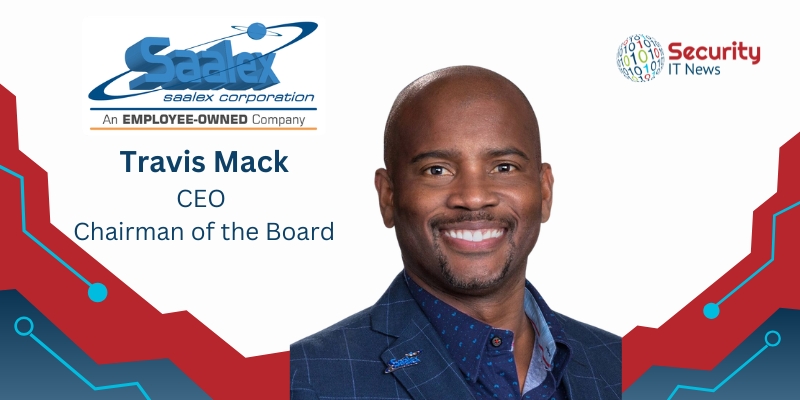
Saalex Corporation is a veteran-owned technology leader. Founded in 1999 by visionary leader Travis Mack, Saalex Corporation has grown into a leading provider of advanced engineering and information technology solutions. Today, the company delivers cutting-edge capabilities in artificial intelligence, automation, software modernization and development, IT, and cybersecurity to customers across the defense, space, and intelligence sectors. At the heart of Saalex is its people-first culture. As an Employee Stock Ownership Plan (ESOP) company, every team member has a vested interest in the company’s success, fostering a collaborative environment built on accountability, innovation, and shared achievement.
Mr. Travis Mack provides executive operational leadership and direction for the Saalex Corporation, Valeo Networks, and the Greenwood Self Storage Fund. He provides oversight and guidance for each organization’s strategic growth and tactical operational initiatives.
Mr. Mack has been the Chairman & CEO of the Saalex Corporation for over 27 years, a federal aerospace and defense contractor employing over 1200 people nationwide serving the Army, Navy, Air Force, NASA, and Municipal governments. Travis is also the founder of “The Mack Foundation,” a philanthropic non-profit organization that provides support, scholarships, and educational opportunities to kids and families from underserved communities.
Prior to founding Saalex Corporation, he served in the U.S. Navy for over 7 years. He is a decorated service-disabled Veteran and holds a Bachelor of Science in Business Management.
Can you share the most interesting story that happened to you since you started your career, especially one that shaped your leadership approach at your current company?
Early in Saalex’s history, I made the decision to implement an Employee Stock Ownership Plan. At the time, a lot of people questioned it. Why would you give away ownership of something you built from scratch? But I had spent more than seven years in the Navy, and one thing military service teaches you is that mission success depends on every single person feeling like they have a stake in the outcome.
I wanted to bring that same mentality into how we run Saalex. Today, Saalex is 40% employee-owned, and I believe that decision is the single biggest reason we have been able to grow the way we have. When your people are owners, they think differently. They take care of customers differently. They stay longer and they perform at a higher level. That one decision shaped everything about how I lead this company.
What initially brought you to this specific career path, and how did it lead to your role in this company?
I served in the U.S. Navy for more than seven years, and that experience gave me both the discipline and the exposure to defense technology that eventually led me to start Saalex. When I left the service, I had a Bachelor of Science in Business Management and a clear understanding of what the Department of Defense needed from its technology and engineering support contractors. I founded Saalex in 1999 with a focus on providing mission-critical IT and engineering services to the warfighter.
Over the past 25-plus years, I have grown the company through more than 11 strategic acquisitions, expanding our capabilities into advanced engineering, digital modernization, artificial intelligence, cybersecurity, and software development. I also continued investing in my own development along the way, completing executive leadership programs at Dartmouth’s Tuck School of Business, USC Marshall, UCLA Anderson, and Clark Atlanta University.
Every step of that journey reinforced the same lesson: if you want to build something that lasts, you have to keep learning and you have to keep investing in people.
What makes Saalex stand out from competitors in the market? Can you share an example that highlights this?
Two things set Saalex apart. First, our ownership model. We are an employee-owned company, and that creates a level of accountability and commitment that you simply do not get in a typical contractor environment. Our people are not just working on a contract; they are building something they own. Second, we move faster than companies ten times our size. A great example is our ASCENT Innovation Lab, which we just launched. ASCENT stands for Advanced Systems, Cloud Engineering and Next Gen Technologies.
It is a secure, cloud-based environment where our teams can rapidly prototype, design, test, and scale digital solutions from concept through operational delivery. Where some development teams deliver two releases a year, our approach through the ASCENT Lab enables three or more releases per day. That kind of speed matters when the warfighter is waiting on capabilities. While larger contractors are still planning their digital transformation, we are already building, testing, and delivering AI-driven solutions in a secure cloud environment.
Are you working on any exciting new products or projects? How do you think this innovation will positively impact your customers?
Absolutely. Beyond the ASCENT Innovation Lab, we recently launched the Saalex AI Management System, or SAIMS, which provides access to advanced AI capabilities across environments. We are also investing heavily in Unattended Robotic Process Automation, what we call URPA, and in Digital Workforce Agents that can automate repetitive tasks and free up our customers’ personnel to focus on higher-value work.
One of the most impactful things we are doing is legacy software modernization. Many of our defense customers are running mission-critical systems on aging monolithic architectures that are expensive to maintain and slow to update. We take those systems apart, analyze them with advanced tooling, and reconstruct them as microservices that can be independently deployed and updated without risk to the broader system. The result is that finished capabilities reach the warfighter in hours or days instead of months or years.
What was the tipping point for Saalex’s recent success? Was there a change in strategy or approach that others might learn from?
The tipping point was the decision to evolve Saalex from a traditional services company into an Advanced Technology Systems Integrator. For years, we were known primarily for test range operations, engineering, and IT support for the Department of Defense. Those are critical capabilities and they remain core to what we do. But about three years ago, we made a deliberate strategic pivot to invest in AI, automation, software modernization, and cybersecurity as growth areas. We backed that up with strategic acquisitions that brought in new technical talent and capabilities.
The results have followed. In 2025, Saalex was ranked #25 on the Washington Business Journal’s Fastest Growing Companies list in the Greater D.C. Area. In 2026, we were ranked #37 among the Largest Government Technology Contractors in Greater Washington, and we won back-to-back Top Workplaces Awards from USA Today and Engineering.com, based entirely on employee feedback.
The lesson for other leaders is that you cannot be afraid to redefine what your company is, even when the current model is working. The defense market is evolving rapidly, and the companies that will thrive are the ones willing to invest ahead of demand.
Can you share a significant challenge your company faced and how you overcame it? What key lesson did that experience provide?
One of the biggest challenges has been integrating acquisitions while preserving the culture that makes Saalex special. When you complete 11-plus acquisitions over the course of 25 years, you are not just combining balance sheets. You are bringing together different teams, different ways of working, and different expectations.
Early on, I learned that the fastest way to destroy the value of an acquisition is to come in and start cutting. Instead, our approach has always been to invest in the people we acquire and, where possible, bring them into the ESOP. When acquired employees become owners, the integration challenge largely takes care of itself. They go from wondering whether they still have a future to realizing they have a stake in something bigger. That lesson applies well beyond M&A: if you want people to perform at their best, give them a reason to care beyond the paycheck.
In just a few words, what differentiates your leadership role from others in the company? What impact does this have on company culture or product success?
I set the vision and I protect the culture. Those are the two things only a CEO can do. Our technical leaders, program managers, and engineers are the ones delivering for our customers every day, and they are exceptional at it. My job is to make sure they have the resources, the strategic direction, and the ownership culture that allows them to do their best work.
The fact that we just won back-to-back Top Workplaces awards from USA Today and Engineering.com, based entirely on what our employees said about working here, tells me that approach is working. At the end of the day, a defense contractor is only as good as its people, and our people are owners. That changes everything.
Related News:
Data Innovation Day Commentary From Experts
SlashID Launches AI Identity Governance to Address Shadow AI