

The best option for you may be different than the best option for the next company. To help you determine which SASE platform is the best fit, we have taken a deep dive into the pros and cons of the top seven platforms on the Gartner SASE platform review and ratings list.
Because the best products usually have a combination of both the most and the highest ratings, we have ordered this list by both. We hope you find value in the following analysis.
1. Cato SASE Cloud
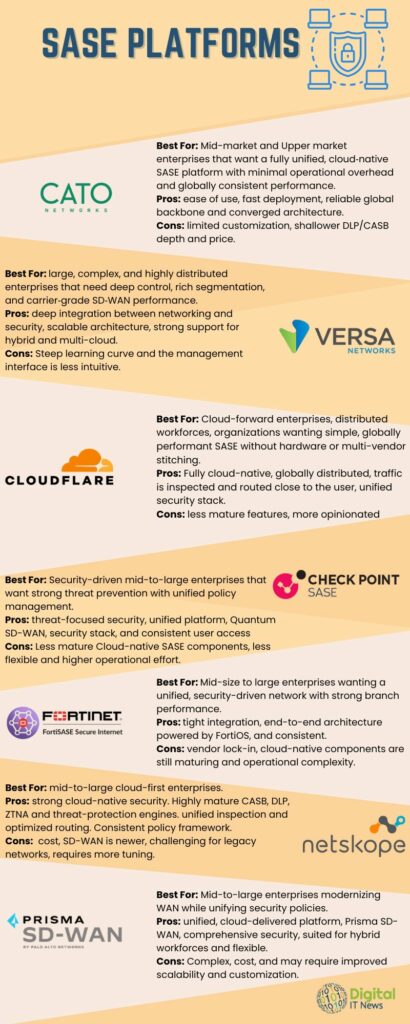
Cato SASE Cloud’s strongest advantages center on its ease of use, fast deployment, reliable global backbone and fully converged architecture. Users consistently praise its intuitive management experience, strong customer support and dependable performance for remote and branch connectivity. Architecturally, Cato stands out because it was built as a single cloud‑native platform rather than stitched together from acquisitions, giving it one policy engine, console and a private global backbone of 85+ PoPs for optimized routing and predictable latency. Peer reviews also highlight straightforward onboarding and rapid feature improvements driven by Cato’s in‑house development model.
The main drawbacks include limited customization, shallower DLP/CASB depth compared to leaders like Netskope or Palo Alto, and higher pricing that can be challenging for smaller organizations. Some users report occasional connection issues and security policy constraints. As a result, Cato SASE Cloud is best suited for mid‑market to upper‑mid‑market enterprises that want a unified, cloud‑native SASE platform with minimal operational overhead, consistent global performance and rapid deployment across distributed sites. It is less ideal for very large enterprises (50,000+ users).
2. Versa SASE with Versa Secure SD-WAN
Versa SASE with Versa Secure SD‑WAN excels when organizations need deep integration between networking and security with a high degree of control. Enterprises value its scalable architecture, rich policy capabilities across SD‑WAN, SWG, ZTNA and CASB and its ability to support complex hybrid and multi‑cloud environments. Because Versa runs on a single operating system (VOS) and offers true multi‑tenancy, it’s especially strong in large, distributed deployments that require segmentation, advanced analytics and flexible deployment options, including cloud, on‑prem and hybrid.
The trade-offs include a steeper learning curve and a management experience that can feel more complex than streamlined SASE platforms. Some teams find the Concerto interface less intuitive and note that Versa’s depth requires more operational maturity. Versa is the best fit for large enterprises and service providers that need maximum configurability, strong Zero Trust enforcement and carrier‑grade SD‑WAN performance. It’s less ideal for smaller IT teams looking for a simple, plug‑and‑play SASE solution with minimal tuning.
3. Cloudflare One with Cloudflare WAN
Cloudflare One with Cloudflare WAN is built for organizations that want a fully cloud‑native, globally distributed SASE platform anchored in one of the world’s largest edge networks. Because Cloudflare runs its own massive anycast network with data centers in nearly every major region, traffic is inspected and routed as close to the user as possible, reducing latency and improving application performance. Cloudflare One unifies ZTNA, SWG, CASB, DLP and email security with identity‑aware policies. At the same time, Cloudflare WAN provides secure, high‑performance connectivity between sites, clouds, and remote users without relying on traditional MPLS or hardware‑heavy SD‑WAN appliances. The result is a lightweight, globally consistent architecture that scales easily and minimizes operational overhead.
The biggest con to consider is Cloudflare’s relative youth in certain advanced SSE and SD‑WAN features compared to long‑established security vendors. While the platform is rapidly evolving, organizations with highly complex WAN topologies or deep customization needs may find Cloudflare’s more opinionated, cloud‑first design less flexible than traditional SD‑WAN solutions. Cloudflare One with Cloudflare WAN is best suited for cloud‑forward enterprises, distributed workforces and organizations that want a simple, globally performant SASE platform without managing hardware or stitching together multiple vendors. It’s less ideal for environments that require extremely granular WAN tuning or legacy network integrations that depend on traditional routing architectures.
4. Check Point Harmony SASE with Check Point SD-WAN
Check Point Harmony SASE, combined with Check Point SD‑WAN, is designed for organizations that want strong, threat‑focused security tightly integrated with a modern WAN fabric. Harmony SASE brings together Check Point’s well‑regarded threat prevention, advanced malware detection, URL filtering, CASB, ZTNA, and DLP into a single cloud‑delivered platform. Quantum SD‑WAN adds application‑aware routing, automated path optimization, and simplified branch connectivity, all managed through a unified console. Because Check Point’s security stack is known for high‑efficacy prevention, this pairing is especially appealing to enterprises that prioritize stopping advanced threats while maintaining consistent user access across remote, branch, and cloud environments.
The challenges with this option often relate to the maturity of Check Point’s cloud‑native SASE components and the operational effort required to leverage its security capabilities. Some organizations find Harmony SASE’s breadth requires more tuning compared to more opinionated, plug‑and‑play SASE platforms, and Quantum SD‑WAN may feel less flexible than long‑established SD‑WAN leaders in highly complex network topologies. Check Point Harmony SASE with Quantum SD‑WAN is best suited for security‑driven mid‑size and large enterprises that want strong threat prevention, unified policy management, and a single‑vendor approach across both security and WAN. It’s less ideal for teams seeking a lightweight, cloud‑first SASE experience or those that need extremely granular WAN customization.
5. FortiSASE with Fortinet Secure SD-WAN
FortiSASE with Fortinet Secure SD‑WAN is built for organizations that want tight integration between security and networking within a single‑vendor ecosystem. Fortinet’s biggest advantage is its end‑to‑end architecture: the same FortiOS operating system powers its firewalls, SD‑WAN, ZTNA, SWG and CASB, which means policies, telemetry and enforcement stay consistent across branches, data centers and remote users. Its ASIC‑accelerated appliances deliver strong on‑prem performance, while FortiSASE extends those capabilities into the cloud for unified inspection and Zero Trust access. For organizations already invested in Fortinet hardware, the combination creates a seamless path to SASE without re‑architecting the entire network.
The main limitations tend to involve vendor lock‑in and operational complexity for teams not already standardized on Fortinet. Some customers note that FortiSASE’s cloud‑native components are still maturing compared to pure‑play SSE providers. Certain advanced capabilities may require additional FortiGate appliances or tuning. FortiSASE with Secure SD‑WAN is the strongest match for mid‑size to large enterprises that want a unified, security‑driven network with strong branch performance and a straightforward extension to cloud‑based security. It’s less suited to organizations seeking a fully cloud‑native SASE stack or those intentionally avoiding a hardware‑centric architecture.
6. Netskope One SASE with Netskope One SD-WAN
Netskope One SASE, paired with Netskope One SD‑WAN, is designed for organizations that want strong cloud‑native security woven directly into their network fabric. Its biggest differentiator is the depth of its security stack: Netskope’s CASB, DLP, ZTNA and threat-protection engines are highly mature and built to understand SaaS, web and cloud traffic at a very granular level. When combined with its SD‑WAN capabilities and the global NewEdge infrastructure, enterprises get consistent inspection, optimized routing and a unified policy framework that follows users and data across every environment.
The problem is the operational overhead and cost, especially for teams that don’t need advanced inspection or data protection. Netskope’s SD‑WAN, while capable, is newer than long‑established WAN platforms, which can matter for organizations with very complex legacy networks. Netskope One SASE is the strongest fit for mid-to-large enterprises that are cloud‑first, heavily invested in SaaS and need rigorous data security with a consolidated architecture. It’s less aligned with smaller IT teams or organizations looking for a lightweight, low‑touch SASE platform rather than deep, cloud‑aware security controls.
7. Prisma SASE with Prisma SD-WAN
Prisma SASE and Prisma SD‑WAN are designed to give organizations a unified, cloud‑delivered platform that strengthens both security and network performance. Prisma SD‑WAN, built from Palo Alto Networks’ CloudGenix acquisition, focuses on application‑aware routing, centralized cloud management and improved branch connectivity, offering strong network performance and simplified deployment. Prisma SASE layers on comprehensive cloud‑delivered security, including SWG, CASB, ZTNA, FWaaS and threat prevention, making it well‑suited for hybrid workforces and distributed environments that need consistent, scalable protection. Together, they support both network‑led and security‑led SASE transformations, giving organizations flexibility depending on whether their primary challenge is WAN modernization or security consolidation.
The challenges noted by users involve Prisma Access’s more complex deployment requirements and Prisma SD‑WAN’s need for improved scalability and customization. Prisma Access tends to have higher upfront costs due to its extensive security capabilities, while Prisma SD‑WAN is seen as more cost‑effective with faster ROI. This combined platform is best suited for mid‑market to large enterprises modernizing their WAN while unifying security policies across remote users, branches and cloud environments. It is less ideal for organizations seeking extremely lightweight management or those with minimal cloud adoption, where the full SASE stack may exceed operational needs.
Which Vendor is the Right Choice for You?
Each of these SASE platforms represents a different philosophy. Prisma is the security‑first choice with deep threat prevention. Netskope is the cloud‑smart, data‑centric option. FortiSASE is ideal for organizations already standardized on Fortinet’s hardware‑driven ecosystem. Check Point Harmony appeals to teams that want high‑efficacy threat prevention above all else. Cloudflare is a pure cloud‑native, globally distributed model built for simplicity and speed. Versa is the power‑user platform for complex WAN environments needing granular control. And Cato is the convergence‑first, ease‑of‑use leader for teams that want a single, unified fabric without operational overhead. None of these is universally “best”. Each is optimized for a specific architecture, IT maturity level, and security posture.
More Networking News
Related News:
The Top 7 Identity Threat Detection & Response- ITDR Vendors in 2026